
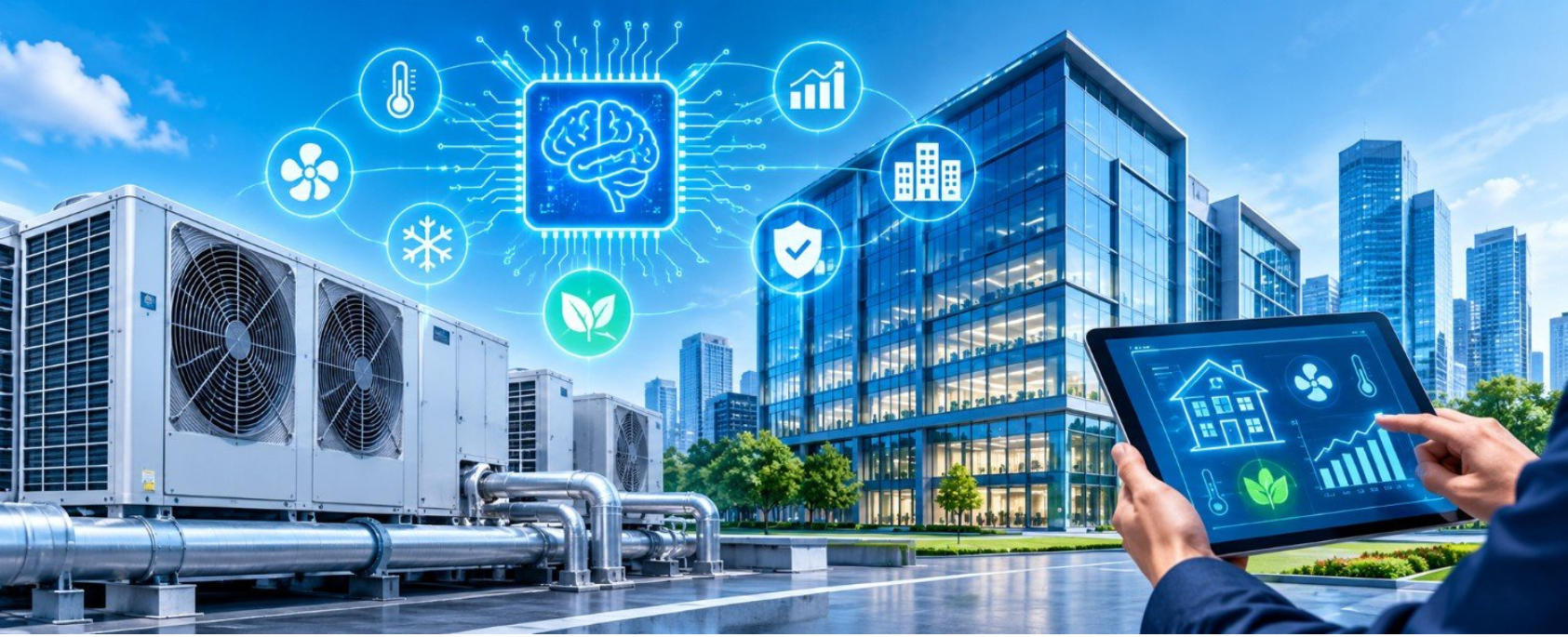
Commercial and industrial buildings are becoming more connected, automated and data-driven. From intelligent lighting to access control and energy monitoring, modern building technologies are changing how facilities are operated and managed.
Heating, Ventilation and Air Conditioning (HVAC) systems are an important part of this transformation. They influence indoor comfort, air quality, energy consumption and the day-to-day performance of commercial and industrial facilities.
Traditionally, HVAC systems have relied on fixed operating schedules, programmed temperature settings and manual adjustments. While these approaches remain useful, they may not always respond efficiently to changing occupancy, weather conditions, equipment performance or operational requirements.
This is where AI-driven HVAC systems are gaining attention.
By combining connected sensors, operational data, analytics and machine learning, artificial intelligence can help building operators understand HVAC performance, identify inefficiencies and make more informed operating decisions.
For facility managers, commercial property owners and industrial operators, understanding AI in HVAC systems is becoming increasingly important when planning smarter, more efficient buildings.
What Are AI-Driven HVAC Systems?
AI-driven HVAC systems use artificial intelligence and data analytics to support the monitoring, control and optimisation of heating, ventilation and air conditioning operations.
These systems can collect information from different sources, analyse operating patterns and recommend or implement adjustments based on predefined objectives.
For example, an AI-powered HVAC solution may analyse:
- Indoor and outdoor temperatures.
- Relative humidity levels.
- Occupancy patterns.
- Equipment operating hours.
- Energy consumption.
- Cooling and heating demand.
- Equipment performance indicators.
- Building operating schedules.
Using this information, the system can help determine when cooling is required, identify unusual equipment behaviour and optimise certain operating parameters.
Conventional HVAC Automation vs AI-Based Optimisation
It is important to understand that conventional HVAC automation and artificial intelligence are not exactly the same.
Traditional automation generally follows predefined rules. For example, a thermostat may activate cooling when the temperature rises above a programmed setpoint.
An AI-assisted system can analyse additional information, such as occupancy, historical energy consumption, weather conditions and previous operating patterns, to support more adaptive decisions.
| Comparison Factor | Conventional HVAC Automation | AI-Based HVAC Optimisation |
| Operation | Follows programmed settings and rules | Uses data analysis to support adaptive decisions |
| Monitoring | Monitors selected system parameters | Can analyse multiple operational data sources |
| Temperature control | Uses programmed setpoints | Can consider occupancy, demand and changing conditions |
| Maintenance | Often based on schedules or reported faults | Can identify unusual patterns and potential faults |
| Energy management | Uses conventional control strategies | Can identify opportunities for operational optimisation |
| Decision-making | Manual or rule-based | AI-assisted recommendations or automated actions |
| Continuous improvement | Requires manual review and adjustment | Can use historical data to refine models and recommendations |
AI does not automatically replace conventional HVAC controls. In many buildings, it works alongside existing automation systems to improve monitoring and decision-making.
How Artificial Intelligence Works in HVAC Systems
Artificial intelligence in HVAC combines connected equipment, sensors, software platforms and analytical models to understand how a building’s climate-control systems operate.
The process generally involves four stages.
Real-Time Data Collection
The first step is collecting relevant information from the building and its HVAC equipment.
Smart sensors and connected devices can measure parameters such as:
- Indoor temperature.
- Outdoor temperature.
- Humidity.
- Occupancy.
- Airflow.
- CO₂ concentration, where suitable sensors are installed.
- Equipment operating status.
- Energy consumption.
For example, occupancy sensors can indicate whether a particular office area is being used. Temperature sensors can identify changes in indoor conditions, while equipment monitoring can provide information about operating hours and performance.
The quality and availability of this data play an important role in the effectiveness of an AI-powered HVAC solution.
Intelligent Monitoring and Analysis
Once the information is collected, AI-enabled software can analyse the data to identify patterns, relationships and unusual operating conditions.
For example, a building may experience high cooling demand during certain hours, even when occupancy is relatively low.
An analytical system can compare occupancy, temperature, equipment operation and energy consumption to identify possible inefficiencies.
Similarly, it may identify unusual changes in equipment performance that deserve further investigation.
This allows facility managers to move beyond basic system monitoring towards more informed, data-driven HVAC management.
Automated HVAC Adjustments
Depending on the system architecture and level of integration, AI can support automated adjustments to HVAC operations.
Examples may include:
- Adjusting temperature setpoints according to occupancy.
- Optimising equipment operating schedules.
- Coordinating cooling demand across different building zones.
- Supporting chilled-water system optimisation.
- Recommending changes to ventilation schedules.
- Adjusting equipment operation based on changing demand.
These adjustments should operate within approved equipment limits, safety requirements and indoor environmental conditions.
In many projects, AI provides recommendations to operators rather than independently controlling every HVAC function.
Continuous System Optimisation
An important feature of AI-based optimisation is the ability to analyse historical operating information.
Over time, machine learning models can identify recurring patterns and improve their predictions when supplied with reliable data.
For example, an office building may have different occupancy levels on weekdays, weekends and public holidays.
An AI-enabled platform can use historical occupancy and energy information to help optimise operating schedules for these different conditions.
However, continuous optimisation depends on accurate sensors, appropriate system integration, reliable data and periodic model validation.
Key Benefits of AI-Driven HVAC Systems
The value of AI-driven HVAC systems extends beyond automated temperature control. They can support better energy management, equipment monitoring and building operations.
Improved Energy Efficiency
HVAC systems can represent a significant share of a commercial building’s energy consumption.
AI-based analytics can help identify where energy is being used inefficiently and where operating adjustments may be beneficial.
For example, an AI-enabled system may identify cooling equipment operating at unnecessary levels during low-occupancy periods.
It can then recommend or implement suitable schedule and setpoint adjustments, subject to operational requirements.
Potential opportunities include:
- Optimising operating schedules.
- Coordinating equipment based on actual demand.
- Identifying unnecessary cooling or heating.
- Monitoring energy consumption across building zones.
- Improving equipment sequencing.
- Identifying abnormal energy-use patterns.
Actual energy savings depend on the existing HVAC system, building conditions, operating practices and quality of implementation. AI does not guarantee a specific reduction in energy consumption.
Predictive Maintenance
Traditional maintenance often relies on scheduled inspections, preventive maintenance plans or corrective action after a problem occurs.
Predictive maintenance in AI-powered HVAC systems adds another layer by analysing equipment data to identify unusual operating patterns that may indicate developing problems.
For example, changes in vibration, temperature, pressure, current consumption or operating behaviour may indicate that a component needs further inspection.
This can help maintenance teams prioritise equipment checks and plan interventions before a potential issue causes significant disruption.
AI-based monitoring supports maintenance decisions, but physical inspection and diagnosis by qualified technicians remain essential.
Better Temperature and Comfort Management
Different areas of a building may have different cooling requirements.
A conference room, office floor, retail area and production space may experience different occupancy patterns and internal heat loads.
Intelligent HVAC systems can use information from multiple sensors to support more responsive zone-level control.
For example, an office floor with fewer occupants may not need the same cooling demand as a fully occupied meeting area.
When properly configured, this approach can help maintain suitable indoor conditions while avoiding unnecessary system operation.
Reduced Operational Costs
AI-assisted HVAC optimisation can help building operators identify opportunities to reduce unnecessary energy use, improve equipment scheduling and plan maintenance more effectively.
Potential operational benefits include:
- Better visibility into energy consumption.
- More informed equipment operating decisions.
- Reduced unnecessary runtime.
- Earlier identification of abnormal equipment behaviour.
- Improved maintenance planning.
- Better utilisation of existing HVAC infrastructure.
However, total cost savings depend on the investment required, integration costs, building performance and ongoing software and maintenance expenses.
Improved Equipment Performance
HVAC equipment operates under changing environmental and operational conditions.
Continuous monitoring can help facility teams understand how equipment performs under different loads and identify deviations from expected operating behaviour.
This information can support better equipment management, troubleshooting and performance optimisation.
It can also help operators understand whether the existing system is being used in line with its intended design.
Smarter Building Operations
AI can bring together information from different building systems to support a more coordinated approach to facility management.
Instead of monitoring HVAC equipment separately, facility teams can use integrated dashboards to understand energy consumption, indoor conditions, equipment status and operational trends.
This creates opportunities for more informed decision-making across the building.
Role of AI in Smart Building Management
A smart building uses connected technologies to monitor and manage its infrastructure more effectively.
Smart building management systems can bring together HVAC, lighting, energy monitoring, access control and other building services.
AI can enhance these systems by analysing information across different operational areas.
Here are some important integrations.
Building Management Systems (BMS)
A Building Management System provides a central platform for monitoring and controlling building services.
Depending on its configuration, a BMS may monitor HVAC equipment, electrical systems, pumps, lighting and other building infrastructure.
AI-enabled analytics can work with compatible BMS data to identify operating patterns, support fault detection and recommend optimisation opportunities.
Smart Sensors
Smart sensors collect real-time information about indoor and outdoor conditions.
Temperature, humidity, occupancy, pressure and air-quality sensors can provide useful inputs for HVAC monitoring and control.
The quality, calibration and positioning of these sensors are important for accurate system decisions.
Occupancy Monitoring
Occupancy information can help determine how building spaces are being used.
AI-enabled systems can analyse occupancy patterns and support HVAC scheduling according to actual demand.
This may be useful in offices, hotels, conference centres and retail buildings where occupancy varies throughout the day.
Automated Lighting
Smart lighting systems can adjust illumination based on occupancy, daylight availability and operating schedules.
When integrated with building management platforms, lighting and HVAC data can contribute to a more complete understanding of building activity and energy demand.
Energy Management Platforms
Energy management platforms collect information about electricity consumption and equipment performance.
AI-based analytics can help identify consumption patterns, unusual usage and potential opportunities for operational improvement.
Building Performance Dashboards
Centralised dashboards allow facility managers to view important information from multiple building systems.
They can provide visibility into:
- HVAC operating status.
- Temperature and humidity trends.
- Energy consumption.
- Equipment alerts.
- Occupancy information.
- Maintenance requirements.
This can make day-to-day building management more structured and data-driven.
Applications of AI-Driven HVAC Systems
The applications of AI-driven HVAC systems for commercial buildings vary according to the facility’s size, operating conditions and environmental requirements.
Commercial Office Buildings
Office buildings experience changing occupancy throughout the day.
AI-enabled HVAC platforms can analyse occupancy, temperature and operating schedules to support demand-based climate control.
For example, cooling requirements in meeting rooms may change significantly depending on the number of occupants.
AI-assisted optimisation can help align HVAC operation with actual building usage.
Hotels and Hospitality Facilities
Hotels have different climate-control requirements across guest rooms, restaurants, kitchens, lobbies, conference spaces and service areas.
An intelligent HVAC management platform can help operators monitor different zones and understand variations in energy demand.
Occupancy information and operating schedules may also support more effective room-level and common-area HVAC management.
Shopping Malls and Retail Spaces
Shopping malls and retail facilities have changing visitor numbers, varying operating hours and different cooling requirements across zones.
AI-assisted monitoring can help analyse occupancy patterns, outdoor conditions and equipment performance.
This information may support better HVAC scheduling and more coordinated operation across large areas.
Manufacturing Facilities
Industrial HVAC requirements can be more complex than conventional office cooling.
Manufacturing facilities may need to maintain specific temperature, humidity, ventilation and environmental conditions to support production activities.
AI in industrial HVAC management can help operators analyse equipment performance, monitor operating patterns and identify unusual system behaviour.
Depending on the application, AI-assisted monitoring may support:
- Cooling equipment performance analysis.
- Ventilation monitoring.
- Equipment condition tracking.
- Energy-use analysis.
- Maintenance planning.
- Environmental condition monitoring.
For industrial environments, any AI-based adjustment must remain compatible with process requirements, safety conditions and approved operating limits.
Hospitals and Healthcare Buildings
Healthcare facilities require careful environmental control across patient rooms, laboratories, operating theatres and other specialised areas.
HVAC performance can influence indoor comfort, ventilation and pressure relationships in critical spaces.
AI-enabled monitoring may help facility teams analyse equipment performance and identify unusual operating conditions.
However, healthcare HVAC systems must comply with the relevant environmental, infection-control and safety requirements. AI recommendations must never override critical design parameters or approved operating procedures.
Data Centres
Data centres generate significant heat through servers and other IT equipment.
Maintaining suitable temperature and airflow conditions is essential for reliable operations.
AI-assisted HVAC analytics can help analyse cooling demand, airflow patterns, equipment performance and energy consumption.
For facilities with appropriate monitoring infrastructure, this information may support more efficient cooling strategies and help identify potential equipment issues.
AI-Driven HVAC vs Traditional HVAC Systems
The difference between traditional HVAC and AI-driven HVAC is primarily the level of data analysis and adaptability.
Traditional systems can provide effective climate control through thermostats, sensors, programmable controllers and conventional automation.
AI-enabled systems build on these capabilities by analysing larger amounts of operational information and supporting more adaptive decisions.
| Factor | Traditional HVAC | AI-Driven HVAC |
| Operation | Fixed settings or conventional controls | Data-driven optimisation |
| Monitoring | Basic system monitoring | Advanced data analysis across connected systems |
| Maintenance | Scheduled or reactive maintenance | Can support predictive maintenance |
| Energy management | Conventional control strategies | Adaptive optimisation based on available data |
| Occupancy response | Depends on installed controls | Can use occupancy data to support adjustments |
| System adjustments | Manual or programmed | AI-assisted recommendations or automated adjustments |
| Performance analysis | Periodic manual review | Continuous or scheduled analytical insights |
| Building integration | Depends on installed automation | Can integrate with compatible BMS and IoT platforms |
It is important to remember that a traditional HVAC system with advanced programmable controls is not automatically an AI-driven system.
The use of artificial intelligence involves additional analytical capabilities, such as machine learning, pattern recognition, predictive modelling or optimisation algorithms.
How AI Helps With Predictive HVAC Maintenance
Unexpected HVAC equipment failure can disrupt business operations, affect indoor comfort and increase repair costs.
For commercial and industrial facilities, even a relatively small equipment issue can affect productivity if it remains undetected.
Predictive maintenance in AI-powered HVAC systems uses equipment data and analytical models to help identify potential performance problems.
Equipment Performance Monitoring
Connected sensors and monitoring devices can collect information about equipment operating conditions.
Depending on the system, this may include:
- Temperature.
- Pressure.
- Vibration.
- Electrical current.
- Operating hours.
- Flow rates.
- Equipment status.
Identifying Unusual Operating Patterns
AI-based analytics can compare current operating data with historical patterns or expected performance.
For example, a sudden change in motor vibration or abnormal temperature readings may indicate a condition that requires investigation.
Detecting Potential Faults
Analytical models can identify patterns associated with possible equipment faults.
These alerts can help maintenance teams prioritise inspections and investigate issues before they become more serious.
However, an alert indicates a potential issue, not a confirmed equipment failure.
Maintenance Planning
When potential problems are identified earlier, facility managers may be able to plan inspections, spare parts and maintenance activities more effectively.
This can help reduce the dependence on emergency repairs and support better maintenance coordination.
Reducing Unexpected Downtime
Predictive insights may help reduce the likelihood of certain unexpected failures by giving maintenance teams more information about equipment condition.
However, predictive maintenance cannot eliminate all breakdowns. Regular preventive maintenance, physical inspection, testing and qualified technical support remain necessary.
Challenges of Implementing AI in HVAC Systems
Although AI-powered HVAC solutions offer several potential advantages, implementing them requires careful planning.
Businesses should evaluate the technical, financial and operational requirements before adopting these technologies.
Initial Investment
AI integration may involve additional expenditure on sensors, communication devices, software platforms, system upgrades and professional implementation.
The investment should be evaluated against the building’s energy consumption, operational requirements and expected long-term benefits.
Integration With Existing HVAC Equipment
Older HVAC equipment may not provide the data or connectivity required by modern AI platforms.
Some systems may need additional sensors, communication gateways, controllers or BMS upgrades.
Compatibility should be assessed before selecting an integration solution.
Sensor and Data Quality
AI-based analysis depends on the quality of its input data.
Incorrect sensor readings, poor calibration, missing information or unsuitable sensor placement can affect the accuracy of analytical results.
Regular sensor checks and data validation are therefore important.
Cybersecurity and Data Protection
Connected building systems can introduce cybersecurity considerations.
Businesses should evaluate network security, user permissions, software updates, data access policies and vendor security practices.
Building management systems should be integrated using appropriate cybersecurity controls.
Technical Expertise and Maintenance
AI-enabled HVAC platforms require a combination of HVAC knowledge, controls expertise, software support and data management.
Facility teams may need training to understand system recommendations, interpret alerts and manage automated operating strategies.
Ongoing technical support is also important to maintain system reliability.
How to Prepare a Building for AI-Based HVAC Integration
Businesses do not necessarily need to replace their entire HVAC infrastructure to explore AI-based optimisation.
In some buildings, suitable monitoring and analytics capabilities can be added to existing systems, subject to equipment compatibility.
A structured assessment can help determine where AI integration may provide value.
Step 1:Evaluate the Existing HVAC Infrastructure
Review the installed equipment, system configuration, controls, operating schedules and maintenance history.
Identify whether the current system supports digital monitoring and communication with external platforms.
Step 2: Review BMS and Automation Compatibility
Determine whether the existing Building Management System can communicate with the proposed AI platform.
Check supported protocols, available data points, controller compatibility and integration requirements.
Step 3: Identify Suitable Sensors and Monitoring Points
Identify the parameters that need to be monitored.
These may include temperature, humidity, occupancy, pressure, airflow and energy consumption.
Sensor selection and placement should be based on the building’s HVAC design and operational requirements.
Step 4: Assess Energy Consumption Patterns
Review historical energy bills, equipment operating hours and available energy monitoring data.
This can help identify areas where operational optimisation may be worth investigating.
Step 5: Define Performance Objectives
Before introducing AI, establish what the building is trying to improve.
Possible objectives include:
- Reducing unnecessary HVAC energy consumption.
- Improving indoor temperature consistency.
- Identifying equipment performance issues.
- Improving maintenance planning.
- Increasing visibility into system operations.
- Optimising operating schedules.
Clear objectives make it easier to evaluate whether the technology is delivering measurable value.
Step 6: Plan System Integration and Ongoing Monitoring
Work with qualified HVAC and automation professionals to develop an integration plan.
The plan should include equipment compatibility, control responsibilities, safety limits, cybersecurity, testing, commissioning and ongoing performance review.
A phased implementation may be more practical than introducing advanced automation throughout an entire facility at once.
The Future of AI in Commercial and Industrial HVAC
The role of artificial intelligence in HVAC is expected to expand as buildings become more connected and data availability improves.
Several developments are likely to influence the next generation of smart building management.
Autonomous HVAC Optimisation
Future HVAC platforms may be able to make more operating decisions automatically within approved parameters.
This could include adjusting schedules, coordinating equipment and responding to changing building conditions.
Human oversight and safety controls will remain important.
Digital Twins for Building Performance
Digital twins are virtual representations of physical buildings or building systems.
When connected to real-time operational data, they can help facility managers understand system behaviour, test scenarios and evaluate potential improvements.
AI can enhance these models by analysing data and supporting performance predictions.
Advanced Predictive Maintenance
As equipment monitoring becomes more detailed, predictive maintenance models may become better at identifying unusual operating patterns and prioritising inspections.
This could help maintenance teams make more informed decisions about equipment servicing and replacement.
IoT-Connected HVAC Equipment
The Internet of Things (IoT) allows connected devices and equipment to exchange operational information.
More connected HVAC equipment can provide additional data for monitoring, analysis and building management.
AI-Powered Energy Management
AI can help analyse energy consumption across multiple building systems and identify opportunities to improve operational efficiency.
This may become increasingly important as businesses focus on energy costs, sustainability objectives and building performance.
Integration With Smart Building Platforms
HVAC systems are likely to become more closely integrated with lighting, occupancy monitoring, security and energy management platforms.
This will support a more connected approach to managing commercial and industrial facilities.
How Vigasa Industries Supports Modern HVAC Requirements
As building technologies evolve, the foundation of effective HVAC performance remains strong engineering, appropriate system selection, professional installation and reliable maintenance.
For commercial and industrial projects, adopting advanced technologies requires an understanding of the building’s cooling requirements, ventilation needs, equipment configuration and long-term operating conditions.
Vigasa Industries provides HVACR solutions and engineering services for commercial, industrial, healthcare, institutional and residential environments.
Its published capabilities cover several important stages of the HVAC project lifecycle.
HVAC Engineering and System Design
Effective HVAC planning begins with understanding the building’s requirements.
Vigasa’s engineering and planning capabilities include heat-load calculations, system selection, duct design, ventilation design and project-specific HVAC planning.
These activities help establish the technical foundation for an efficient and reliable HVAC installation.
Commercial and Industrial HVAC Projects
Different buildings require different climate-control strategies.
Vigasa works across commercial and industrial environments, including offices, manufacturing facilities, healthcare buildings, warehouses and institutional projects.
Its HVACR capabilities support projects with varying cooling, ventilation and operational requirements.
System Installation and Project Execution
A well-designed HVAC system also requires proper installation and execution.
Vigasa’s project services include installation, site coordination, testing, balancing and commissioning.
These stages help verify that the installed system is operating in line with the approved project requirements.
HVAC Optimisation and Maintenance
After installation, ongoing system performance becomes an important consideration.
Vigasa provides after-sales support, preventive maintenance, equipment audits, troubleshooting, performance optimisation and Annual Maintenance Contracts (AMCs).
These services can help businesses maintain equipment reliability and identify opportunities for operational improvement.
Supporting Modern Building Requirements
AI and smart building technologies can add new capabilities to HVAC management. However, successful implementation depends on the quality of the underlying HVAC infrastructure and its integration with monitoring and control systems.
Vigasa’s engineering, execution and maintenance capabilities provide an important foundation for businesses planning modern HVAC projects.
For organisations exploring HVAC upgrades, energy optimisation or improved system performance, Vigasa Industries can be a partner for discussing project-specific HVAC requirements.
To explore its capabilities, visit the HVAC services page or contact Vigasa Industries.
Conclusion
AI-driven HVAC systems are creating new opportunities for smarter building management by combining connected equipment, real-time monitoring, data analytics and intelligent optimisation.
From energy management and occupancy-based control to predictive maintenance and equipment performance analysis, artificial intelligence can help businesses make more informed decisions about their HVAC infrastructure.
However, successful implementation requires more than installing software. It depends on reliable HVAC equipment, accurate sensors, compatible controls, quality engineering and ongoing technical support.
For commercial and industrial building owners, the most practical approach is to begin with a clear understanding of existing HVAC performance and identify where connected monitoring and AI-assisted optimisation can deliver measurable value.
Planning a commercial or industrial HVAC project? Connect with Vigasa Industries to discuss your HVAC design, installation, optimisation and maintenance requirements.
Frequently Asked Questions
An AI-driven HVAC system uses artificial intelligence, connected sensors and data analytics to support heating, ventilation and air conditioning operations. It can analyse building conditions, occupancy, equipment performance and energy consumption to help optimise system operation.
AI can analyse operating schedules, occupancy patterns, temperature conditions and energy consumption to identify opportunities for optimisation. It may support demand-based cooling, equipment scheduling and more efficient system operation. Actual savings depend on the building, HVAC equipment and implementation.
AI-based predictive maintenance tools can analyse equipment data to identify unusual operating patterns that may indicate developing faults. These insights can help maintenance teams prioritise inspections, but physical diagnosis and servicing by qualified technicians are still necessary.
Traditional HVAC systems generally use conventional thermostats, programmed schedules and control strategies. Smart HVAC systems use connected sensors and digital controls for enhanced monitoring and automation. AI-driven HVAC takes this further by using advanced analytics and machine learning to support more adaptive decisions.
In some cases, yes. Existing HVAC equipment may be integrated with AI-based monitoring or optimisation platforms through compatible controllers, sensors, communication gateways and BMS connections. A technical assessment is required to determine compatibility and the extent of upgrades needed.
AI can analyse information from HVAC equipment, occupancy sensors, energy platforms and compatible building management systems. This helps facility managers identify operating patterns, monitor building performance and make more informed decisions about energy and equipment management.
They can be suitable for industrial buildings where equipment monitoring, energy management and environmental control are important. However, implementation must account for process requirements, ventilation needs, equipment specifications, safety conditions and the facility's operational priorities.