
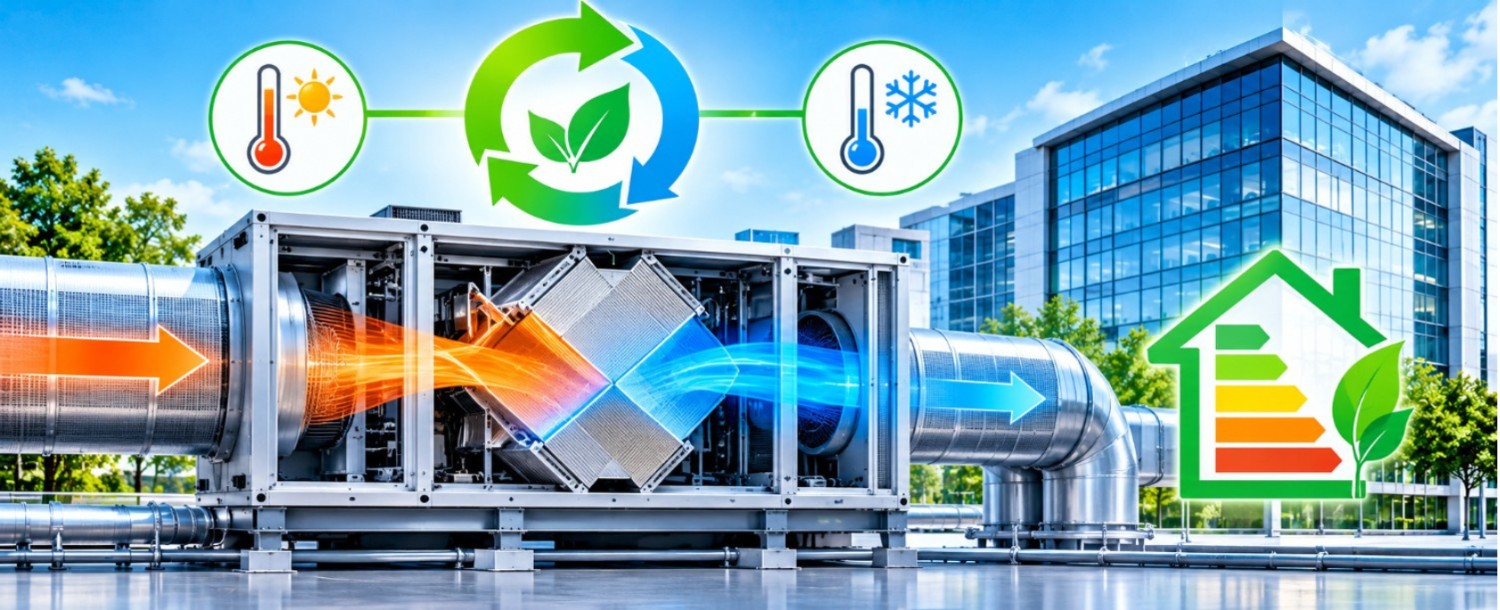
Heating, cooling and ventilation are essential for maintaining comfortable, healthy and productive indoor environments. However, these operations also contribute significantly to the energy requirements of commercial buildings and industrial facilities.
A conventional HVAC system often exhausts conditioned indoor air while bringing in fresh outdoor air. The energy used to heat or cool the exhausted air is lost unless a suitable recovery system is installed.
This is where heat recovery systems in HVAC play an important role.
Heat recovery technology captures a portion of the thermal energy that would otherwise be wasted and transfers it to another air stream or process. This can reduce the amount of heating or cooling required from the main HVAC equipment, helping improve overall system efficiency.
For facility managers, HVAC consultants, commercial property owners and industrial operators, understanding HVAC heat recovery systems is important when evaluating energy conservation opportunities and planning efficient building infrastructure.
This article explores how heat recovery works, the different technologies available, their commercial and industrial applications, and the factors to consider before selecting a suitable system.
What Is a Heat Recovery System in HVAC?
A heat recovery system in HVAC is a technology that captures usable thermal energy from an outgoing air stream, exhaust stream or process and transfers it to another stream that requires heating or cooling.
The purpose is to reuse energy that would otherwise be discharged into the environment.
For example, consider a commercial building during winter. Indoor air is being exhausted through the ventilation system, while cold outdoor air is introduced to maintain fresh-air supply.
Instead of allowing all the thermal energy in the outgoing air to go to waste, a heat exchanger can transfer some of that energy to the incoming outdoor air.
As a result, the incoming air reaches a more favourable temperature before it enters the heating coil or air-handling system.
The same principle can work during cooling seasons. Cooler exhaust air from an air-conditioned building can help pre-cool warmer incoming outdoor air, reducing the cooling demand on the HVAC equipment.
Heat Recovery vs Conventional Heating and Cooling
In a conventional ventilation arrangement, incoming fresh air may need to be heated or cooled almost entirely by the HVAC system.
With heat recovery technology, a portion of the required thermal energy is transferred from an outgoing stream to the incoming stream.
This does not eliminate the need for heating or cooling equipment. Instead, it reduces the additional conditioning required under suitable operating conditions.
Heat recovery can be applied in two broad ways:
- Air-to-air heat recovery: Transfers energy between exhaust air and incoming fresh air.
- Waste heat recovery: Captures usable thermal energy from industrial equipment or process exhaust and uses it for another heating or process requirement.
Both approaches support HVAC energy conservation, but their equipment selection and design requirements can be quite different.
How Do HVAC Heat Recovery Systems Work?
The working principle of HVAC heat recovery systems is based on transferring thermal energy between two streams that have different temperatures or energy conditions.
In ventilation applications, the two streams are generally:
- Supply air – fresh outdoor air entering the building.
- Exhaust air – indoor air being removed from the building.
A heat exchanger allows energy to move between these streams. Depending on the technology, the air streams may remain physically separated or interact through a specialised energy-transfer medium.
Heat Exchange Between Air Streams
When warm exhaust air and cooler outdoor air pass through a heat exchanger, thermal energy moves from the warmer stream towards the cooler stream.
During winter, warm indoor exhaust air can preheat incoming outdoor air.
During summer, cooler indoor exhaust air can help pre-cool incoming outdoor air when the indoor air conditions are favourable.
In many plate-type heat exchangers, the two air streams pass through separate channels. This allows thermal energy to transfer without the air streams directly mixing.
Other technologies, such as rotary heat recovery wheels, use a rotating heat-transfer medium to move energy between the streams.
The amount of energy recovered depends on several factors, including airflow rates, temperature difference, exchanger effectiveness and operating conditions.
Preconditioning Incoming Air
The incoming fresh air is partially heated or cooled before it reaches the main HVAC conditioning equipment.
This process is known as preconditioning.
For example:
- During winter, recovered heat can increase the temperature of incoming outdoor air.
- During summer, recovered cooling energy can reduce the temperature of incoming outdoor air.
- In suitable systems, moisture transfer can also help reduce the additional humidity-control load.
Because the incoming air has already been partially conditioned, the heating or cooling coil may require less energy to achieve the desired supply-air condition.
Integration With HVAC Equipment
Heat recovery equipment is generally integrated with the building’s ventilation and air-conditioning infrastructure.
Common integration points include:
- Air Handling Units (AHUs).
- Fresh-air supply systems.
- Exhaust-air systems.
- Dedicated Outdoor Air Systems (DOAS).
- Ventilation ductwork.
- Heating and cooling coils.
- Building Management Systems (BMS).
The integration must account for airflow requirements, pressure drop, filtration, equipment capacity, controls and maintenance access.
A properly designed arrangement helps ensure that heat recovery supports the performance of the overall HVAC system rather than creating additional operational problems.
Types of Heat Recovery Systems Used in HVAC
Different buildings and industrial facilities have different thermal requirements. Therefore, the selection of heat recovery systems in HVAC depends on the application, airflow conditions, temperature differences, humidity levels and available installation space.
The following are some commonly used technologies.
Heat Recovery Ventilators (HRV)
A Heat Recovery Ventilator (HRV) transfers sensible heat between incoming fresh air and outgoing exhaust air.
Sensible heat refers to thermal energy that changes air temperature without transferring moisture.
For example, during winter, an HRV can transfer heat from warm indoor exhaust air to cold outdoor supply air.
This helps increase the incoming air temperature before it reaches the heating equipment.
HRVs are commonly considered for buildings that require controlled ventilation and want to reduce heating or cooling losses associated with exhausting conditioned air.
Key characteristics:
- Transfers sensible heat.
- Generally keeps supply and exhaust air streams separate.
- Can reduce the heating or cooling demand associated with fresh-air conditioning.
- Requires appropriate airflow balancing and heat-exchanger maintenance.
Energy Recovery Ventilators (ERV)
An Energy Recovery Ventilator (ERV) can transfer both sensible heat and latent energy between incoming and outgoing air streams.
Latent energy is associated with moisture in the air.
Unlike a standard HRV, an ERV uses an energy-transfer medium that can allow controlled moisture transfer as well as heat transfer.
For example, in a humid cooling season, an ERV may transfer some moisture from the incoming outdoor air towards the exhaust air stream. This can help reduce the dehumidification load on the HVAC system.
During suitable winter conditions, moisture transfer can also help manage indoor humidity.
Key characteristics:
- Transfers sensible heat.
- Can transfer moisture between air streams.
- Helps manage both temperature and humidity loads.
- Can be useful in buildings with significant ventilation and humidity-control requirements.
HRV vs ERV: What Is the Difference?
| Comparison Factor | HRV | ERV |
| Full form | Heat Recovery Ventilator | Energy Recovery Ventilator |
| Sensible heat transfer | Yes | Yes |
| Moisture transfer | Generally no | Yes, depending on design |
| Main function | Transfers thermal energy | Transfers thermal energy and moisture |
| Humidity management | Does not intentionally transfer moisture | Can help manage moisture transfer |
| Typical applications | Buildings where sensible heat recovery is the main requirement | Buildings where both temperature and moisture recovery are beneficial |
The choice between HRV and ERV should be based on the building’s climate, indoor humidity conditions, ventilation requirements and exhaust-air characteristics.
An ERV is not automatically better than an HRV. The correct selection depends on the specific application.
Heat Recovery Wheels
A heat recovery wheel, also known as a rotary heat exchanger, uses a rotating wheel containing a heat-transfer medium.
The wheel passes alternately through the exhaust-air stream and the incoming supply-air stream.
As it moves through the warmer stream, the wheel absorbs thermal energy. When it rotates into the cooler stream, it releases that stored energy.
Depending on the wheel material and design, it may transfer:
- Sensible heat only.
- Sensible heat and a portion of the moisture.
Some enthalpy wheels use specialised materials to support moisture transfer.
Heat recovery wheels are commonly considered for larger ventilation systems and commercial air-handling applications.
Important design considerations:
- Wheel effectiveness.
- Airflow balance.
- Pressure drop.
- Seal performance.
- Purge arrangements, where applicable.
- Cross-leakage and carryover risks.
- Cleaning and maintenance requirements.
The suitability of a rotary wheel depends on the nature of the exhaust air and the level of separation required between supply and exhaust streams.
Plate Heat Exchangers
A plate heat exchanger transfers thermal energy through a series of closely arranged plates.
Supply and exhaust air pass through separate channels, allowing heat to move through the conductive plate material.
The two air streams generally remain physically separated in a conventional plate exchanger.
This makes plate heat exchangers useful where direct mixing of exhaust and supply air needs to be avoided.
Depending on the design, plate exchangers may use:
- Aluminium plates.
- Other conductive materials.
- Specialised membrane materials for energy and moisture transfer.
Key characteristics:
- No rotating heat-transfer wheel.
- Separate supply and exhaust passages.
- Compact equipment arrangements are possible.
- Requires consideration of condensation, frost formation and pressure drop.
- Plate and passage surfaces need periodic inspection and cleaning.
A plate exchanger is suitable when its airflow capacity, material and performance characteristics match the building’s requirements.
Run-Around Coil Systems
A run-around coil system uses two separate heat-exchanger coils connected by a closed-loop fluid circuit.
One coil is installed in the exhaust-air stream, while the other is placed in the incoming supply-air stream.
A circulating fluid absorbs thermal energy from one coil and transports it to the other.
For example, during winter:
- Warm exhaust air transfers heat to the first coil.
- The circulating fluid carries this thermal energy through the pipe circuit.
- The second coil transfers the recovered heat to incoming outdoor air.
The two air streams do not need to be located next to each other, making this arrangement useful where ductwork layouts or building configurations prevent a direct air-to-air heat exchanger installation.
Key characteristics:
- Supply and exhaust air streams remain physically separate.
- Coils can be installed at a distance from each other.
- Requires circulation pumps and connecting pipework.
- Performance depends on fluid flow, coil design and operating temperatures.
- Additional pump energy and maintenance must be considered.
Waste Heat Recovery Systems
Waste heat recovery in HVAC involves capturing usable thermal energy from industrial processes, equipment exhaust or other heat-generating operations.
Manufacturing plants and industrial facilities often release heat through exhaust gases, hot process fluids, equipment cooling systems and other process streams.
Instead of allowing all this energy to escape unused, a suitable heat recovery arrangement can transfer it to another application.
Possible uses include:
- Preheating fresh or makeup air.
- Preheating process water.
- Supporting space heating.
- Preheating boiler feedwater, where technically appropriate.
- Supporting other compatible industrial heating requirements.
Waste heat recovery systems may use heat exchangers, coils, heat pipes or other technologies depending on the source temperature, fluid characteristics and intended application.
Industrial waste heat recovery requires detailed engineering because temperature, contamination, corrosion, pressure and process-safety considerations can vary significantly.
Key Benefits of Heat Recovery Systems in HVAC
The main advantage of HVAC heat recovery systems is their ability to reuse available thermal energy rather than depending entirely on newly generated heating or cooling.
The benefits vary according to the selected technology, building conditions and system design.
Reduced Heating and Cooling Loads
Incoming outdoor air often needs substantial heating or cooling before it can be supplied to occupied spaces.
A heat recovery system can partially precondition this air using energy from the outgoing exhaust stream.
This reduces the additional heating or cooling required from the main HVAC equipment under suitable conditions.
Lower Energy Consumption
When the heating or cooling load is reduced, the associated HVAC equipment may consume less energy.
For example, an AHU may require less heating-coil output when incoming air has already been preheated through heat recovery.
Similarly, pre-cooling outdoor air can reduce the load on cooling equipment during suitable summer conditions.
Actual energy savings depend on operating hours, airflow rates, climate, equipment effectiveness, fan energy and the overall HVAC design.
Improved Ventilation Efficiency
Commercial and industrial buildings need appropriate fresh-air supply to maintain indoor environmental conditions.
However, increasing outdoor-air ventilation can also increase heating and cooling demand.
Heat recovery ventilation helps address this challenge by recovering some of the energy from outgoing air while maintaining the required ventilation arrangement.
This allows building operators to consider ventilation and energy performance together.
Better Utilisation of Available Thermal Energy
Industrial and commercial operations may produce usable thermal energy that is otherwise discharged.
Heat recovery helps identify opportunities to reuse this energy for another compatible application.
This can improve the overall utilisation of energy within a facility.
Potential Reduction in Operating Costs
Reduced heating and cooling loads can contribute to lower energy costs.
However, the overall financial benefit should account for:
- Equipment purchase and installation.
- Additional ductwork or pipework.
- Fan and pump energy.
- Maintenance.
- Cleaning and inspection.
- Controls and system integration.
- Expected operating hours.
A proper lifecycle cost evaluation is more useful than relying only on the initial equipment cost or a general energy-saving percentage.
Improved Overall HVAC Performance
When correctly selected and integrated, heat recovery equipment can support more efficient operation of AHUs, ventilation systems and other HVAC components.
It can also help facility managers improve energy monitoring and identify opportunities to optimise building performance.
Applications of Heat Recovery Systems in Commercial and Industrial Buildings
Commercial HVAC heat recovery and industrial heat recovery applications vary according to building use, ventilation requirements and available waste-heat sources.
Some common applications include:
- Office Buildings
Office buildings require continuous or scheduled fresh-air supply to support indoor air quality and occupant comfort.
During periods of heating or cooling demand, exhaust air can be used to precondition incoming outdoor air through an HRV, ERV or another suitable heat exchanger.
This can help reduce the additional energy required for ventilation-air conditioning.
- Hotels and Hospitality Facilities
Hotels have different ventilation requirements across guest rooms, kitchens, restaurants, conference areas and common spaces.
Heat recovery can be considered in suitable fresh-air and exhaust-air systems to reduce the conditioning load.
However, exhaust streams from kitchens, bathrooms and other areas may have different contamination and humidity characteristics. Each application needs separate technical evaluation.
- Shopping Malls
Shopping malls have large occupied spaces, multiple ventilation zones and varying visitor levels.
Heat recovery can be integrated into selected AHUs and ventilation systems to improve the energy performance of outdoor-air conditioning.
The system should be designed around the mall’s operating hours, fresh-air requirements and exhaust-air characteristics.
- Hospitals and Healthcare Facilities
Hospitals require carefully designed ventilation systems for different areas, including patient rooms, laboratories and specialised clinical spaces.
Heat recovery may be suitable in selected applications, but it must be evaluated carefully against infection-control requirements, exhaust-air contamination risks and pressure relationships.
A heat recovery arrangement should never compromise the required separation between critical air streams.
- Manufacturing Plants
Manufacturing facilities can have significant opportunities for industrial heat recovery systems.
Industrial processes may release thermal energy through hot exhaust air, equipment cooling and process fluids.
Depending on the source and application, recovered energy may be used to preheat makeup air, water or another process stream.
The system must account for exhaust temperature, dust, chemicals, moisture, corrosion and process operating conditions.
- Warehouses and Industrial Facilities
Warehouses and industrial buildings may require ventilation, temperature management and process-related cooling.
Heat recovery can be considered where suitable exhaust and supply streams are available.
For example, a facility with a consistent warm exhaust stream may be able to recover energy for incoming makeup air during colder operating conditions.
The technical and economic suitability depends on the available heat source and the building’s heating or cooling demand.
Heat Recovery vs Traditional HVAC Ventilation Systems
A conventional ventilation system supplies outdoor air and exhausts indoor air according to the building’s ventilation requirements.
Without heat recovery, much of the thermal energy contained in the exhausted air is lost.
A heat recovery ventilation system introduces a heat exchanger to recover a portion of that energy.
| Factor | Conventional Ventilation | Heat Recovery Ventilation |
| Exhaust air | Discharged outside | Can transfer useful thermal energy before discharge |
| Incoming fresh air | Conditioned independently | Can be preconditioned using recovered energy |
| Energy consumption | Depends on heating and cooling loads | Can reduce incoming-air conditioning demand |
| System complexity | Generally simpler | Requires additional heat-exchange equipment |
| Maintenance | Standard HVAC maintenance | Includes heat exchanger inspection and cleaning |
| Initial investment | Generally lower | Higher due to additional equipment and integration |
| Energy management | No recovery from exhaust air in a basic arrangement | Reuses a portion of available thermal energy |
Heat recovery ventilation does not replace the need for proper ventilation, filtration or temperature control.
Its purpose is to improve the energy performance of the ventilation process while meeting the building’s required indoor environmental conditions.
Factors to Consider Before Choosing a Heat Recovery System
Selecting the right heat recovery system for HVAC requires a technical assessment of the building and its operating conditions.
A system that performs well in one facility may not be appropriate for another.
Important selection factors include:
- Building Type and Application
The requirements of an office building, hospital, hotel and manufacturing plant can be very different.
The selected technology must match the building’s ventilation, heating, cooling and operational needs.
- Fresh-Air Requirements
Determine the required outdoor-air volume and the expected exhaust-air volume.
The supply and exhaust airflow rates influence the performance and sizing of the heat recovery equipment.
- Exhaust Air Temperature and Humidity
The temperature and moisture conditions of the exhaust stream influence the type and amount of energy that can be recovered.
For example, an ERV may be suitable when moisture transfer is beneficial, while an HRV may be more appropriate when sensible heat recovery is the primary requirement.
- Airflow Rates
Heat exchangers must be selected for the required airflow conditions.
Incorrect sizing can affect recovery effectiveness, pressure drop and overall system performance.
- Heat Recovery Effectiveness
Effectiveness indicates how well a heat exchanger transfers energy under specified operating conditions.
Equipment should be evaluated using performance data relevant to the intended airflow rates, temperatures and humidity conditions.
- Pressure Drop
Air passing through a heat exchanger experiences resistance.
A higher pressure drop can increase the energy required by the fans.
Therefore, the energy recovered must be evaluated against the additional fan energy required to move air through the equipment.
- Contamination Risks
Exhaust air may contain dust, grease, chemicals, moisture, odours or other contaminants.
The selected system must prevent unacceptable transfer of contaminants into the supply-air stream.
This is particularly important in healthcare facilities, kitchens, laboratories and industrial environments.
- Available Installation Space
Heat recovery equipment may require additional space for the exchanger, ductwork, access panels, filters, pumps or connecting pipework.
The installation arrangement should allow sufficient space for inspection and maintenance.
- Maintenance Requirements
The equipment may require periodic cleaning, filter replacement, seal inspection, coil checks and performance monitoring.
Maintenance requirements should be considered before selecting the technology.
- Initial and Operating Costs
The investment should be evaluated against the expected operating conditions and long-term benefits.
A lifecycle cost analysis should include equipment, installation, additional fan or pump energy, maintenance and expected energy savings.
Common Challenges in HVAC Heat Recovery Installation
Although heat recovery technology offers energy conservation opportunities, an incorrectly designed or installed system may not deliver the expected performance.
Some common challenges include:
- Incorrect System Sizing
An undersized exchanger may not provide the required recovery capacity, while an oversized system may increase equipment and installation costs without providing proportional benefits.
Accurate airflow and thermal calculations are essential.
- Incompatible Supply and Exhaust Airflow
Heat recovery performance depends on the relationship between supply and exhaust airflow rates.
Poor airflow balancing can reduce the effectiveness of the system and affect building ventilation.
- High Pressure Drop
An exchanger that creates excessive resistance can increase fan energy consumption.
The net energy benefit should account for both recovered thermal energy and additional fan power.
- Contaminant Transfer Risks
Rotary wheels and other recovery devices may have carryover or leakage considerations.
Where exhaust air contains hazardous or undesirable contaminants, equipment selection and airflow arrangement require particular care.
In some applications, an indirect run-around coil system may be preferable because the two air streams remain physically separated.
- Insufficient Maintenance
Dust accumulation, blocked filters, dirty heat-transfer surfaces and damaged seals can affect system performance.
Regular inspection and cleaning are necessary to maintain the intended heat-transfer capacity and airflow.
- Poor Integration With Existing HVAC Equipment
Heat recovery systems must work in coordination with existing AHUs, fans, ductwork, heating and cooling coils and controls.
Poor integration can create airflow imbalance, control issues or additional operating costs.
- Limited Installation Space
Existing buildings may not have enough room for additional equipment, ductwork or maintenance clearances.
A site assessment is particularly important when retrofitting heat recovery into an operational facility.
How Heat Recovery Supports Sustainable Building Operations
Energy conservation is an important part of sustainable building management.
Energy recovery systems in HVAC can contribute by reducing avoidable thermal losses and improving the use of energy already available within a building or industrial process.
Reducing Avoidable Energy Losses
Exhaust air and industrial process streams can contain usable thermal energy.
Recovering a portion of this energy can reduce the demand for additional heating or cooling under suitable operating conditions.
Improving HVAC Energy Performance
Heat recovery can help reduce the thermal load on heating and cooling equipment.
When combined with appropriate controls, ventilation design and regular maintenance, it can contribute to better overall HVAC energy performance.
Supporting Building Energy Management
Heat recovery systems can be monitored as part of a wider building energy management strategy.
Facility managers can review airflow, temperature, energy consumption and equipment performance to identify opportunities for improvement.
Reducing Energy-Related Emissions
Lower energy consumption can contribute to reduced energy-related greenhouse gas emissions, depending on the energy source used by the facility.
The actual environmental benefit depends on the system’s energy savings, electricity or fuel mix, operating hours and lifecycle impact.
Contributing to Sustainability Goals
Businesses increasingly evaluate energy performance as part of their environmental and operational objectives.
Heat recovery can be one component of a broader strategy that also includes efficient equipment, improved insulation, smart controls, ventilation optimisation and preventive maintenance.
Why Professional HVAC Design Matters for Heat Recovery
The performance of HVAC heat recovery solutions depends heavily on correct engineering, equipment selection and system integration.
A heat exchanger alone cannot guarantee energy savings. Its performance depends on how well it is matched to the building’s requirements.
Professional HVAC design should include the following stages:
- Thermal Load Assessment
Evaluate the heating and cooling loads, fresh-air requirements and available exhaust-air conditions.
This helps determine whether heat recovery is technically and economically suitable.
- Airflow Calculations
Calculate the required supply and exhaust airflow rates.
These values influence equipment capacity, duct sizing and the expected recovery performance.
- Equipment Selection
Choose the appropriate HRV, ERV, heat recovery wheel, plate exchanger, run-around coil or industrial waste heat recovery arrangement.
Selection should consider performance, contamination risks, operating conditions and maintenance requirements.
- Heat Exchanger Sizing
The heat exchanger should be sized according to the expected airflow, temperature difference, humidity conditions and required effectiveness.
Pressure drop and additional fan or pump energy must also be included in the assessment.
- Ductwork and Piping Design
Proper duct and piping design helps maintain the required airflow and fluid circulation.
Insulation, access panels, drainage and equipment clearances should also be considered where applicable.
- System Integration
The heat recovery arrangement must work with the existing or proposed HVAC equipment.
This includes AHUs, ventilation fans, coils, controls and building management systems.
- Testing and Commissioning
After installation, the system should be tested to verify airflow, equipment operation, controls, temperature conditions and overall performance.
Testing and commissioning help confirm that the installed system operates according to the approved design.
- Preventive Maintenance
Regular maintenance helps preserve heat-transfer performance and equipment reliability.
Filters, heat exchangers, seals, coils, fans and other components should be inspected according to manufacturer recommendations and operating conditions.
How Vigasa Industries Supports Commercial and Industrial HVAC Requirements
Implementing energy-conscious HVAC systems requires more than selecting individual equipment. It involves understanding the building’s thermal requirements, ventilation needs, engineering constraints and long-term operational objectives.
Vigasa Industries provides HVACR engineering and project services for commercial, industrial, healthcare, institutional and residential environments.
Its published capabilities cover several important stages of HVAC project delivery.
HVAC Engineering and Design
Effective heat recovery planning begins with understanding the building’s requirements.
Vigasa’s published design and planning capabilities include HVAC system design, heat-load calculations, duct design, ventilation planning, equipment selection and energy-efficiency analysis.
These activities provide an important engineering foundation when evaluating opportunities for HVAC energy conservation.
Commercial and Industrial HVAC Projects
Different facilities have different heating, cooling and ventilation requirements.
Vigasa works across commercial and industrial environments, including corporate offices, healthcare facilities, manufacturing plants, warehouses and processing units.
Its commercial HVAC solutions and broader HVAC project capabilities support project-specific requirements across different building types.
System Installation and Project Execution
Proper installation and integration are essential for reliable HVAC operation.
Vigasa’s project services include installation, site coordination, testing, balancing and commissioning.
These activities help verify that HVAC equipment and associated systems operate according to the approved project specifications.
HVAC Maintenance and Technical Support
After installation, ongoing maintenance is important for preserving equipment performance and reliability.
Vigasa provides preventive maintenance, equipment health audits, troubleshooting, performance optimisation and Annual Maintenance Contracts (AMCs).
Its after-sales HVAC services support businesses in maintaining their HVAC infrastructure throughout its operational life.
Energy-Conscious HVAC Planning
Heat recovery can be considered as part of a broader strategy to improve HVAC energy performance.
The suitability of a specific heat recovery system depends on the available heat source, ventilation requirements, equipment compatibility and project economics.
Vigasa’s engineering and execution capabilities can support businesses in evaluating their commercial and industrial HVAC requirements.
For organisations planning new HVAC infrastructure, system upgrades or energy-efficiency improvements, visit Vigasa Industries to explore its services and discuss project-specific requirements.
Conclusion
Heat recovery systems in HVAC offer commercial and industrial buildings an opportunity to reuse thermal energy that would otherwise be wasted.
From HRVs and ERVs to heat recovery wheels, plate heat exchangers, run-around coils and industrial waste heat recovery systems, different technologies can support energy conservation in different applications.
However, the right solution depends on the building’s ventilation requirements, available heat sources, airflow conditions, contamination risks and operating costs.
Successful implementation requires accurate engineering, suitable equipment selection, proper installation, testing and regular maintenance.
For facility managers and industrial decision-makers, heat recovery should be evaluated as part of a complete HVAC energy-efficiency strategy rather than as a standalone equipment upgrade.
Planning a commercial or industrial HVAC project? Connect with Vigasa Industries to discuss your HVAC engineering, installation, optimisation and maintenance requirements.
Frequently Asked Questions
A heat recovery system in HVAC captures thermal energy from outgoing exhaust air or another heat source and transfers it to incoming air or a different application. It helps reduce the additional heating or cooling required by the main HVAC equipment.
Heat recovery reduces energy demand by reusing available thermal energy. For example, warm exhaust air can preheat incoming outdoor air during winter, reducing the work required from the heating system. During suitable cooling conditions, recovered cooling energy can also help pre-cool incoming air.
An HRV transfers sensible heat, which changes air temperature. An ERV transfers sensible heat and can also transfer moisture between air streams. The choice depends on the building's climate, humidity conditions and ventilation requirements.
Heat recovery systems are used in commercial offices, hotels, shopping malls, healthcare facilities, manufacturing plants, warehouses and other buildings with suitable ventilation or waste-heat sources.
Yes. Industrial heat recovery systems can capture thermal energy from process exhaust, equipment cooling and other suitable sources. Recovered energy may be used for makeup-air heating, water preheating or other compatible applications. The system must be designed around process conditions, contamination risks and safety requirements.
Many air-to-air heat recovery systems can transfer energy in both heating and cooling seasons. During winter, they can preheat incoming air. During summer, they may help pre-cool incoming air when the exhaust-air conditions are favourable. The actual benefit depends on indoor and outdoor temperatures, humidity and system controls.
Maintenance requirements depend on the equipment type. Common activities include filter cleaning or replacement, heat exchanger inspection, coil cleaning, seal checks, airflow verification, drainage inspection and performance monitoring. Maintenance should follow the manufacturer's recommendations and site operating conditions.