
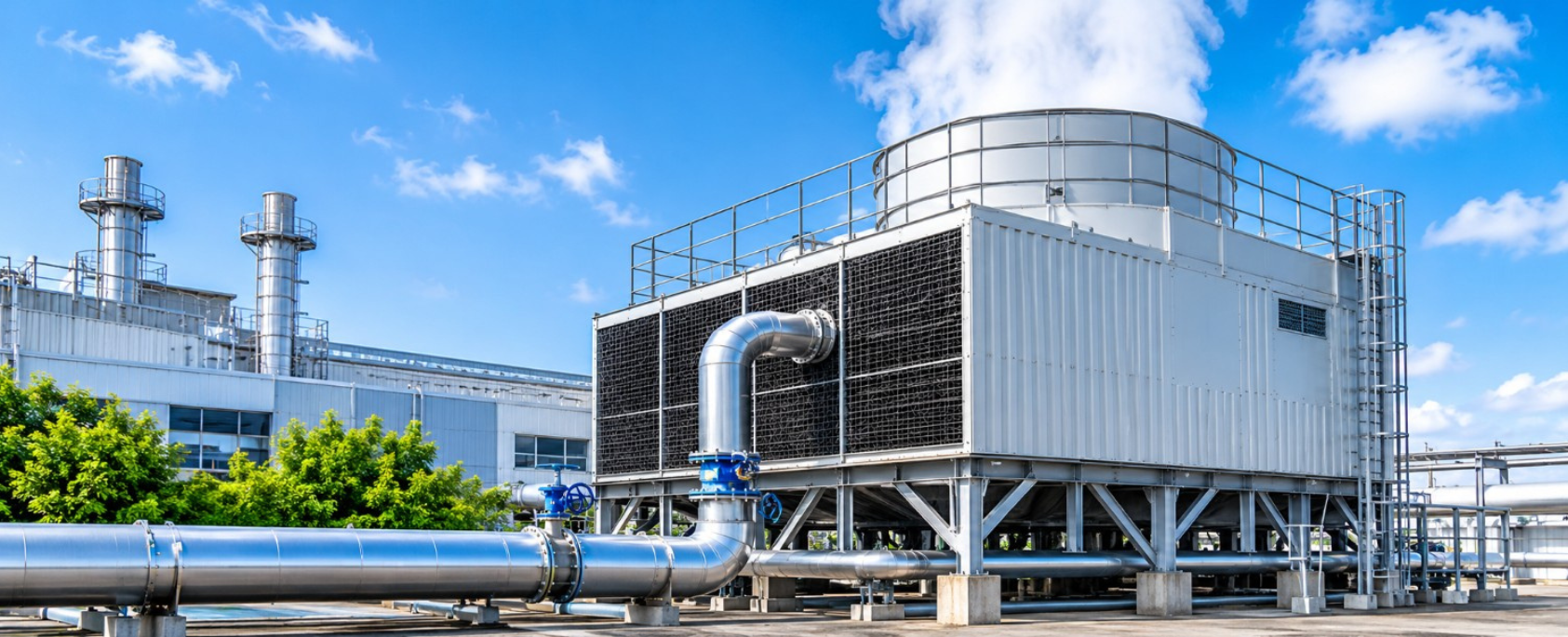
Cooling towers play an important role in industrial cooling operations. They help remove unwanted heat from circulating water and release it into the atmosphere, allowing chillers, heat exchangers and industrial processes to operate within their required temperature ranges.
However, a cooling tower does more than simply cool water. Its performance directly influences the efficiency of connected equipment, particularly in water-cooled chiller plants. Poor heat rejection can increase chiller energy consumption, affect cooling capacity and contribute to higher operating costs.
This makes cooling tower efficiency an important consideration for facility managers, plant operators and industrial decision-makers.
Factors such as ambient wet-bulb temperature, cooling tower range and approach, airflow, water distribution, fill condition and water quality all influence cooling tower performance.
Understanding these parameters helps businesses identify performance problems, improve maintenance practices and make informed decisions about industrial cooling operations.
In this guide, we explore how industrial cooling towers work, how their efficiency is measured, common causes of performance loss and practical ways to improve their operation.
What Is Cooling Tower Efficiency?
Cooling tower efficiency refers to how effectively a cooling tower removes heat from circulating water and brings its temperature closer to the ambient air’s wet-bulb temperature.
An industrial cooling tower works primarily through evaporative cooling. Hot water enters the tower and comes into contact with moving air. A small portion of the water evaporates, absorbing heat from the remaining water and lowering its temperature.
The cooled water is then collected and returned to the connected cooling system.
The main objective is to reject the heat absorbed by chillers or industrial processes so that the circulating water can be reused.
Understanding the Cooling Tower Working Principle
The basic cooling tower operation involves three important elements:
- Hot water: Water returning from the condenser or industrial process carries heat that needs to be rejected.
- Ambient air: Air moves through the tower and supports heat and mass transfer.
- Cooled water: After heat rejection, the water temperature decreases and the water returns to the cooling circuit.
The cooling process involves two mechanisms:
Evaporative Heat Transfer
A small portion of the circulating water evaporates into the moving air. This evaporation removes latent heat from the remaining water and lowers its temperature.
Sensible Heat Transfer
Heat can also transfer between water and air because of their temperature difference. The contribution of sensible heat transfer depends on the operating conditions.
In most conventional evaporative cooling towers, evaporation is the dominant cooling mechanism.
It is important to understand that a cooling tower does not generate refrigeration in the same way as a chiller. Its function is to reject heat from the cooling-water circuit into the atmosphere.
How Does an Industrial Cooling Tower Work?
An industrial cooling tower operates through a continuous cycle of water circulation and heat rejection.
The process can be explained in four stages.
- Hot Water Enters the Cooling Tower
Water absorbs heat from connected equipment, such as a water-cooled chiller condenser or an industrial process heat exchanger.
This warmer water is pumped towards the cooling tower and distributed across the fill or heat-transfer surface.
- Water Comes Into Contact With Airflow
The cooling tower distributes hot water through spray nozzles or another designed water-distribution arrangement.
At the same time, fans or natural draft move air through the tower.
The water spreads over the fill media, increasing the contact area between water and air.
- Heat Is Transferred to the Air
As air moves through the tower, a portion of the water evaporates.
This evaporation removes heat from the remaining water and lowers its temperature.
The heated, moisture-laden air is discharged from the tower.
- Cooled Water Returns to the Cooling System
The cooled water collects in the cold-water basin at the bottom of the tower.
It is then circulated back to the condenser or industrial process to absorb heat again.
This continuous cycle allows the cooling system to reject heat while maintaining the required operating conditions.
Key Factors That Affect Cooling Tower Efficiency
Several environmental, mechanical and operational factors influence cooling tower performance.
Understanding these factors helps facility managers identify why a cooling tower may not achieve its expected cooling-water temperature.
- Wet-Bulb Temperature and Ambient Conditions
The ambient wet-bulb temperature is one of the most important factors affecting evaporative cooling tower performance.
Wet-bulb temperature represents the cooling potential of the surrounding air through evaporation.
A cooling tower cannot normally cool water below the entering-air wet-bulb temperature under ordinary evaporative operation.
When wet-bulb temperature increases, the temperature difference available for evaporative cooling decreases. The tower may therefore deliver warmer water under otherwise comparable operating conditions.
When wet-bulb temperature decreases, the tower may be able to produce colder leaving water.
This is why cooling tower performance should always be evaluated alongside actual weather and operating conditions.
- Cooling Tower Range and Approach
Range and approach are two important parameters used to understand cooling tower performance.
Cooling Tower Range is the difference between the hot water temperature entering the tower and the cold water temperature leaving it.
A higher range indicates that the water has experienced a larger temperature reduction. However, range is influenced by the heat load and circulating water flow rate, so a higher range does not automatically mean a more efficient tower.
Cooling Tower Approach is the difference between the cold water temperature leaving the tower and the entering-air wet-bulb temperature.
A smaller approach generally indicates that the tower is cooling water closer to the ambient wet-bulb temperature.
Approach is an important indicator of the tower’s thermal capability when evaluated at comparable operating conditions.
- Airflow and Fan Performance
Airflow is essential for heat and mass transfer inside the cooling tower.
Mechanical-draft cooling towers use fans to move air through the tower.
Insufficient airflow can reduce heat rejection and increase the cold-water temperature.
Factors affecting airflow include:
- Fan blade condition.
- Fan speed.
- Motor performance.
- Gearbox condition, where fitted.
- Belt tension, where applicable.
- Air inlet obstruction.
- Fan alignment.
- Air recirculation around the tower.
Regular inspection of fans, motors and associated components helps maintain the required airflow.
- Water Flow Rate and Distribution
Water must be distributed evenly across the cooling tower fill.
Uneven distribution can create dry areas, reduce the effective heat-transfer surface and lead to inconsistent cooling.
Common causes include:
- Blocked spray nozzles.
- Damaged distribution pipes.
- Incorrect water flow.
- Clogged strainers.
- Poor basin operation.
- Uneven water pressure.
Proper water distribution helps maintain effective contact between air and water.
- Fill Media Condition
Fill media increases the contact area between water and air, improving heat and mass transfer.
Over time, fill media can become blocked or damaged because of scale, dirt, biological growth and poor water quality.
This can reduce airflow, interfere with water distribution and affect heat rejection.
Regular inspection and cleaning help maintain the intended fill performance.
- Scaling, Fouling and Water Quality
Cooling tower water continuously loses a portion of its volume through evaporation. Dissolved minerals remain in the circulating water, which can increase their concentration over time.
This may lead to scale formation on wetted surfaces.
Other water-quality problems include:
- Suspended solids.
- Corrosion products.
- Biological growth.
- Algae and slime.
- Sediment accumulation.
These deposits can reduce heat-transfer effectiveness, obstruct water flow and increase maintenance requirements.
A suitable water-treatment programme is therefore essential for reliable cooling tower operation.
- Drift and Evaporation Losses
Cooling towers lose water through evaporation, drift and blowdown.
Evaporation Loss: Water changes into vapour during the cooling process. This is a normal and necessary part of evaporative cooling.
Drift Loss: Small water droplets are carried out of the tower with the exhaust air. Proper drift eliminators help minimise this loss.
Blowdown Loss: A portion of circulating water is intentionally discharged to control dissolved solids and prevent excessive mineral concentration.
These losses influence water consumption and operating costs. Their management should balance water conservation with appropriate water quality and hygiene requirements.
Important Parameters for Measuring Cooling Tower Performance
Monitoring the right parameters helps facility managers evaluate cooling tower efficiency and identify changes in system performance.
Three important thermal parameters are range, approach and effectiveness.
- Cooling Tower Range
Range is the difference between the entering hot-water temperature and the leaving cold-water temperature.
Formula:
[
\text{Range}=T_{\text{Hot Water}}-T_{\text{Cold Water}}
]
For example:
- Hot water entering the tower: 37°C
- Cold water leaving the tower: 32°C
[
\text{Range}=37-32=5^\circ C
]
<text color=”secondary” size=”sm”>Illustrative example only. Actual design and operating temperatures vary by system.</text>
- Cooling Tower Approach
Approach is the difference between the cold-water temperature leaving the tower and the entering-air wet-bulb temperature.
Formula:
[
\text{Approach}=T_{\text{Cold Water}}-T_{\text{Wet Bulb}}
]
For example:
- Cold water leaving the tower: 32°C
- Ambient wet-bulb temperature: 27°C
[
\text{Approach}=32-27=5^\circ C
]
A lower approach generally means the cooling tower is bringing water closer to the theoretical evaporative cooling limit.
However, achieving a lower approach may require a larger tower, more airflow, greater fan energy or other design trade-offs.
- Cooling Tower Effectiveness
Cooling tower effectiveness indicates how closely the tower approaches the theoretical cooling limit represented by the entering-air wet-bulb temperature.
It is commonly expressed as the ratio of the actual water temperature reduction to the maximum theoretical temperature reduction available under the same inlet conditions.
Formula:
[
\text{Effectiveness}=
\frac{\text{Range}}{\text{Range}+\text{Approach}}\times100
]
Using the earlier example:
- Range: 5°C
- Approach: 5°C
[
\text{Effectiveness}=
\frac{5}{5+5}\times100=50%
]
<text color=”secondary” size=”sm”>This is an illustrative thermal effectiveness calculation, not a measured performance rating for a particular cooling tower.</text>
Quick Comparison of Performance Parameters
| Parameter | What It Measures | Performance Interpretation |
| Range | Temperature reduction across the tower | Influenced by heat load and water flow |
| Approach | Difference between cold-water temperature and wet-bulb temperature | Lower approach generally indicates closer cooling to the wet-bulb limit |
| Effectiveness | Actual range compared with the theoretical available range | Higher effectiveness indicates a closer approach to the theoretical cooling limit |
These parameters should be recorded together with water flow, heat load, entering-air conditions and fan operation.
A single temperature reading is not enough to determine whether a cooling tower is operating efficiently.
Why Cooling Tower Efficiency Matters in Industrial HVAC Systems
Cooling towers are important heat-rejection components in many industrial and commercial HVAC systems.
Their performance can influence the operation of chillers, process cooling equipment and associated water-circulation systems.
- Improves Heat Rejection Performance
The primary function of a cooling tower is to remove heat from circulating water.
If the tower cannot reject the required heat, the temperature of the water returning to the cooling system may increase.
This can affect the operating conditions of connected equipment and reduce the overall stability of the cooling process.
- Supports Efficient Chiller Operation
In a water-cooled chiller system, the cooling tower supplies cooled condenser water to the chiller.
The temperature of this incoming condenser water influences the chiller’s condensing conditions and power requirement.
Under suitable operating conditions, lower condenser-water temperatures can improve chiller efficiency.
However, the cooling tower should not be operated at an unnecessarily low setpoint without considering the chiller manufacturer’s operating limits, tower fan energy and pump energy.
The goal is to optimise the complete chiller plant rather than maximise cooling tower performance in isolation.
- Helps Manage Electricity Consumption
Cooling tower fans, condenser-water pumps and chillers all consume electricity.
Poor tower performance may increase the chiller’s energy requirement or cause equipment to operate for longer periods.
A properly maintained tower and suitable control strategy can help reduce unnecessary energy use across the cooling plant.
- Supports Stable Industrial Process Cooling
Manufacturing plants and industrial facilities often depend on consistent cooling-water conditions.
Cooling towers help remove heat from equipment and process systems.
If the tower performs poorly, connected equipment may experience higher operating temperatures or reduced cooling capacity.
Maintaining suitable heat-rejection performance helps support process stability.
- Reduces Unnecessary Operational Stress
Scaling, fouling, blocked fill and poor airflow can force cooling equipment to operate under less favourable conditions.
Regular performance monitoring and maintenance help identify these issues before they contribute to more significant operational problems.
Common Cooling Tower Problems That Reduce Efficiency
Even a correctly selected cooling tower can lose performance when its components are not maintained or operating conditions change.
Some common problems include:
- Scale and Mineral Deposits
Mineral deposits can form on fill media, water-distribution components and other wetted surfaces.
Scale reduces effective heat-transfer performance and may obstruct water movement.
Regular water-quality monitoring and suitable treatment help control mineral concentration.
- Biological Growth and Algae
Cooling tower water can support the growth of algae, bacteria and other microorganisms under favourable conditions.
Biological growth may create slime, obstruct water passages and interfere with heat transfer.
It can also create important public-health risks, including the potential for Legionella growth and aerosol exposure.
A properly designed and managed water-treatment and cooling-tower water-management programme is essential.
- Blocked or Damaged Fill Media
Debris, scale and biological deposits can block fill passages.
Damaged or displaced fill can also reduce the effective contact between water and air.
Periodic inspection helps identify deterioration and determine whether cleaning or replacement is required.
- Uneven Water Distribution
Blocked spray nozzles or damaged distribution pipes can result in uneven water coverage.
This reduces the effective heat-transfer area and may create localised hot-water zones.
- Fan and Motor Problems
Fan and motor issues can reduce the airflow required for effective cooling.
Common problems include:
- Worn bearings.
- Motor overheating.
- Belt slippage.
- Fan imbalance.
- Incorrect fan rotation.
- Damaged fan blades.
- Electrical or control faults.
These problems should be investigated by qualified maintenance personnel.
- Poor Water Treatment
Inadequate water treatment can contribute to scale, corrosion, sediment and biological growth.
This affects not only thermal performance but also equipment reliability and water-system hygiene.
Water treatment should be based on water chemistry, tower operation and applicable health and safety requirements.
- Air Recirculation
Air recirculation occurs when warm, moisture-laden discharge air re-enters the cooling tower’s air intake.
This increases the entering-air wet-bulb condition and reduces the cooling potential available to the tower.
Poor tower placement, inadequate clearance, nearby structures and unsuitable discharge arrangements can contribute to this problem.
Practical Ways to Improve Cooling Tower Efficiency
Improving cooling tower energy efficiency requires attention to thermal performance, airflow, water quality and connected equipment.
The following practices can help improve operating conditions.
- Maintain Proper Water Distribution
Inspect spray nozzles, distribution pipes and strainers regularly.
Ensure water is distributed evenly across the fill media.
Correct distribution helps maintain effective contact between air and water and reduces localised performance problems.
- Clean and Inspect Fill Media Regularly
Inspect the fill for scaling, fouling, biological growth and physical damage.
Clean or replace affected components according to the manufacturer’s recommendations.
The cleaning method should be suitable for the fill material and should not cause unnecessary damage.
- Monitor Fan and Motor Performance
Check fan speed, blade condition, alignment, vibration and motor operation.
Where variable-speed control is installed, verify that the control system is operating according to the required temperature and load conditions.
- Maintain Appropriate Water Treatment and Blowdown
Monitor important water-quality parameters such as conductivity, pH, hardness and other site-specific indicators.
A suitable water-treatment programme should manage scale, corrosion and biological growth.
Blowdown should be controlled according to water chemistry and the approved treatment strategy rather than being reduced simply to save water.
- Check Airflow and Eliminate Air Recirculation
Inspect air inlets, fan discharge arrangements and surrounding structures.
Ensure that the tower has adequate clearance for air intake and discharge.
Where recirculation is suspected, review tower placement and airflow conditions.
- Monitor Operating Temperatures and Performance Trends
Record the following parameters:
- Hot-water inlet temperature.
- Cold-water outlet temperature.
- Entering-air wet-bulb temperature.
- Cooling tower range.
- Cooling tower approach.
- Water flow rate.
- Fan speed and power.
- Pump operating conditions.
- Chiller condenser-water temperature.
Tracking these values over time helps identify performance changes and investigate potential causes.
- Consider Variable-Speed Fan Control
Variable-frequency drives (VFDs) can allow cooling tower fans to operate at different speeds according to cooling demand.
When correctly selected and controlled, variable-speed operation may reduce unnecessary fan energy consumption during periods of lower heat load or favourable ambient conditions.
However, the control strategy must maintain the required condenser-water temperature and remain within the operating limits of the connected chiller and cooling tower.
Cooling Tower Maintenance and Performance Monitoring
Regular cooling tower maintenance is essential for maintaining heat-transfer performance, equipment reliability and water-system hygiene.
A preventive maintenance programme should cover both mechanical components and water quality.
- Routine Inspection and Cleaning
Inspect the cooling tower for:
- Dirt and debris.
- Scale deposits.
- Biological growth.
- Fill-media damage.
- Blocked nozzles.
- Basin sediment.
- Drift eliminator condition.
- Leakage and corrosion.
Cleaning intervals should be determined by operating conditions, water quality and manufacturer recommendations.
- Water Quality Monitoring
Water quality has a direct influence on cooling tower reliability.
The maintenance programme should include appropriate testing and treatment for:
- Conductivity and dissolved solids.
- pH.
- Scale-forming minerals.
- Corrosion indicators.
- Biological activity.
- Treatment chemical concentration.
Water treatment should also address Legionella risk through an appropriate water-management programme, including cleaning, disinfection, monitoring and corrective action as applicable.
- Fan, Motor and Gearbox Checks
Mechanical inspection should cover fan blades, bearings, belts, gearboxes, couplings, motors and electrical connections, depending on the tower design.
Vibration, unusual noise and temperature changes can indicate developing mechanical problems.
- Temperature and Flow Monitoring
Measure entering and leaving water temperatures under recorded operating conditions.
Also monitor water flow, wet-bulb temperature and fan operation.
These measurements help calculate range and approach and provide a basis for performance comparisons.
- Preventive Maintenance Planning
A structured maintenance programme should include:
- Scheduled inspections.
- Water-treatment checks.
- Mechanical servicing.
- Cleaning and sediment removal.
- Performance testing.
- Maintenance documentation.
- Corrective action planning.
Following the manufacturer’s maintenance recommendations and applicable water-management requirements helps support reliable operation.
Choosing the Right Cooling Tower for Industrial Applications
Selecting an industrial cooling tower involves evaluating the cooling duty, operating conditions and long-term maintenance requirements.
The correct system should match the facility’s actual heat-rejection requirements.
- Cooling Load Requirements
Determine the total heat that must be rejected from the chiller or industrial process.
The cooling tower should be selected for the required heat load under the specified design conditions.
- Design Wet-Bulb Temperature
The design entering-air wet-bulb temperature is an important selection parameter.
The tower must be capable of delivering the required leaving-water temperature at the project’s design wet-bulb condition.
- Required Water Flow and Temperature Range
The required circulating-water flow rate and entering and leaving water temperatures influence tower selection.
These values should be coordinated with the connected chiller or process equipment.
- Available Installation Space
Consider the available footprint, height, structural support and access requirements.
The installation location should also provide suitable air intake and discharge clearances to reduce recirculation.
- Energy and Water Consumption
Evaluate the expected fan and pump energy, evaporation losses, drift and blowdown requirements.
A tower with lower initial cost may not necessarily provide the best lifecycle operating economics.
- Maintenance Accessibility
The design should provide suitable access to fill media, fans, motors, basins, spray nozzles and drift eliminators.
Maintenance access should be considered during the project design stage.
- Operating Environment
Environmental conditions such as ambient temperature, wet-bulb temperature, dust, airborne contaminants and water quality influence equipment selection.
Industrial facilities may require additional consideration for corrosion, process contamination and specialised water-treatment requirements.
The Role of Professional HVAC Engineering in Cooling Tower Performance
Cooling tower performance depends on more than the tower itself.
It is influenced by the connected chiller, condenser-water pumps, piping, controls and overall heat-rejection arrangement.
Professional industrial HVAC solutions should therefore consider the entire cooling system.
- Correct System Sizing and Selection
The cooling tower must be selected according to the required heat-rejection duty, water flow rate and design wet-bulb temperature.
Incorrect selection can result in inadequate cooling capacity or unnecessary capital and operating costs.
- Proper Integration With Chillers and HVAC Equipment
The cooling tower, condenser-water circuit and chiller should operate as a coordinated system.
The design must account for the chiller manufacturer’s allowable condenser-water temperatures, minimum flow requirements and control strategy.
- Efficient Piping and Water Circulation Design
Piping layout, pipe diameter, pump selection and hydraulic balancing influence water flow and pumping energy.
A well-designed arrangement helps maintain the required flow without unnecessary pressure losses.
- Regular Performance Assessment and Maintenance
Performance monitoring helps identify changes in range, approach, water flow, fan energy and overall heat rejection.
Regular inspections and maintenance help address the causes of declining performance before they affect connected equipment.
How Vigasa Industries Supports Industrial HVAC Requirements
Cooling towers are part of a wider HVAC and heat-rejection system. Their performance depends on correct engineering, equipment selection, water circulation, controls and ongoing maintenance.
Vigasa Industries provides HVACR engineering and project services for commercial, industrial, healthcare, institutional and residential environments.
Its published capabilities cover several important areas relevant to industrial cooling infrastructure.
HVAC Engineering and System Design
Vigasa’s engineering capabilities include HVAC design, load calculations, equipment selection, duct design and system planning.
These activities help establish the technical requirements for cooling systems and their integration with associated HVAC equipment.
Industrial HVAC Projects
Industrial facilities require reliable cooling and ventilation infrastructure to support production operations.
Vigasa undertakes commercial and industrial HVAC projects, including system design, equipment selection, procurement support, installation, utility piping, testing and commissioning.
Explore its industrial and commercial HVAC project capabilities.
Installation and Project Execution
Proper installation and system integration are important for reliable cooling operations.
Vigasa’s project execution capabilities include installation and erection, site coordination, testing, balancing, commissioning and quality assurance.
Its HVAC services provide further information about its project delivery and technical support.
Maintenance and Performance Optimisation
Cooling-system performance can change over time because of fouling, water-quality issues, mechanical wear and changing operating conditions.
Vigasa provides preventive maintenance, equipment audits, troubleshooting, performance optimisation and Annual Maintenance Contracts.
Its after-sales HVAC maintenance services support ongoing equipment reliability and system performance.
Supporting Energy-Conscious HVAC Operations
Efficient cooling requires coordinated management of heat rejection, water circulation and connected HVAC equipment.
Vigasa’s engineering, project execution and maintenance capabilities support businesses planning new HVAC infrastructure or improving the performance of existing systems.
For industrial and commercial cooling requirements, visit Vigasa Industries to explore its HVAC capabilities and discuss project-specific requirements.
Conclusion
Cooling tower efficiency is an important factor in the performance of industrial HVAC systems and water-cooled chiller plants.
By removing heat effectively, cooling towers help maintain suitable condenser-water temperatures and support reliable cooling operations.
However, performance depends on several interconnected factors, including wet-bulb temperature, range, approach, airflow, water distribution, fill condition and water quality.
Regular cooling tower maintenance, performance monitoring and proper system design help identify operational issues, improve heat rejection and manage energy and water consumption.
For industrial facilities, the most effective approach is to evaluate the cooling tower as part of the complete HVAC system rather than treating it as an isolated piece of equipment.
Planning an industrial cooling or HVAC project? Connect with Vigasa Industries to discuss HVAC engineering, installation, project execution and maintenance requirements.
Frequently Asked Questions
Cooling tower efficiency describes how effectively a cooling tower removes heat from circulating water and brings its temperature closer to the entering-air wet-bulb temperature. It is commonly evaluated using parameters such as range, approach and thermal effectiveness.
Range is the difference between the hot water entering the cooling tower and the cold water leaving it.
Approach is the difference between the cold water leaving the tower and the ambient entering-air wet-bulb temperature.
Range indicates the temperature reduction across the tower, while approach indicates how closely the tower cools water to the wet-bulb temperature.
Important factors include ambient wet-bulb temperature, cooling tower range and approach, airflow, fan performance, water flow rate, water distribution, fill-media condition, water quality, scaling, biological growth and air recirculation.
Efficiency can be improved through proper water distribution, fill-media cleaning, fan and motor maintenance, suitable water treatment, airflow management and regular performance monitoring. Variable-speed fan control may also help when technically suitable.
Maintenance frequency depends on the cooling tower design, operating conditions, water quality and manufacturer recommendations. Regular inspections, water-treatment monitoring, mechanical checks and cleaning should be included in a documented preventive maintenance and water-management programme.
In a water-cooled chiller plant, the cooling tower rejects heat from the condenser-water circuit. Better heat rejection can help provide lower condenser-water temperatures under suitable conditions, which may reduce the chiller's power requirement. The overall benefit depends on the chiller, cooling tower, pumps, fans and control strategy working together.