
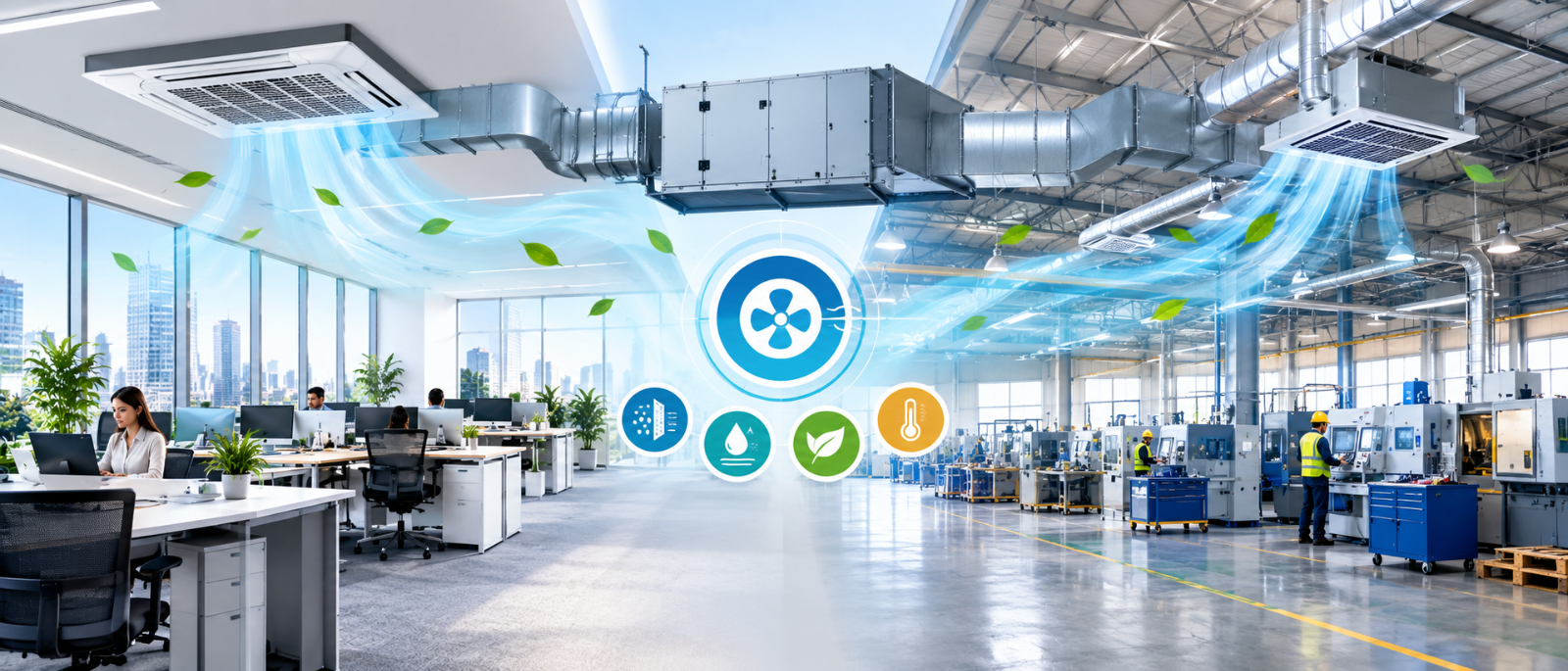
Indoor air quality has become an increasingly important consideration in the design and operation of commercial and industrial buildings. Offices, hotels, hospitals, educational institutions, manufacturing facilities, warehouses and other workplaces all depend on controlled indoor environments for comfort, productivity and efficient operations.
While HVAC systems are traditionally associated with heating and cooling, their role goes much further. A properly designed HVAC system can influence ventilation, fresh-air supply, filtration, temperature, humidity, air distribution and overall indoor environmental conditions.
In commercial buildings, inadequate ventilation, poor filtration, excessive humidity, dust and poorly maintained equipment can contribute to an uncomfortable indoor environment. Industrial facilities may face additional challenges such as process emissions, airborne particles, chemical vapours, machinery-generated heat and specialised ventilation requirements.
This makes HVAC design an important part of indoor air quality management.
The right approach is not simply to install a larger air-conditioning system. Instead, HVAC requirements should be evaluated according to the building type, occupancy, processes, airflow requirements, pollutant sources, filtration needs and operating conditions.
What Is Indoor Air Quality?
Indoor air quality, commonly referred to as IAQ, describes the conditions of the air inside a building and the factors that influence its suitability for occupants and processes.
Several factors can affect indoor air quality, including:
- Fresh-air availability and ventilation
- Temperature
- Humidity
- Airborne dust and particles
- Odours
- Chemical contaminants
- Process emissions
- Microbial contaminants
- Air circulation and distribution
HVAC systems interact with many of these factors.
For example, ventilation systems can introduce outdoor air, filters can help capture airborne particles, air-conditioning systems can regulate temperature, and humidity-control equipment can help manage moisture levels.
However, HVAC is only one part of the overall IAQ strategy. Building design, pollutant sources, occupancy, maintenance and operational practices also need to be considered.
Why Indoor Air Quality Matters in Commercial and Industrial Buildings
Indoor air quality requirements can vary significantly depending on how a building is used.
An office building may primarily require comfortable temperatures, appropriate ventilation and effective filtration. A manufacturing facility, on the other hand, may need to manage process-generated heat, dust, fumes, emissions and large-volume airflow.
Employee Comfort and Productivity
Temperature, humidity, ventilation and odours can all influence how comfortable people feel inside a building.
In commercial workplaces, an HVAC system that provides appropriate airflow and temperature control can contribute to a more comfortable working environment.
Poor airflow distribution or inadequate ventilation may result in areas that feel stuffy, excessively warm or uncomfortable.
Therefore, HVAC design should consider not only the cooling capacity of equipment but also how conditioned and fresh air is distributed throughout occupied spaces.
Health and Well-Being
Indoor spaces can contain particles, dust, odours and other contaminants originating from outdoor air, building materials, cleaning activities, occupants or industrial processes.
A suitable combination of ventilation, filtration, source control and maintenance can help manage indoor environmental conditions.
The objective is not simply to circulate air but to develop an HVAC strategy appropriate to the building’s specific requirements.
Industrial Process Requirements
In industrial environments, indoor air quality can also be connected to production requirements.
Depending on the industry, air conditions may influence:
- Manufacturing processes
- Equipment operating conditions
- Materials
- Product quality
- Worker comfort
- Dust management
- Process ventilation
- Temperature and humidity requirements
For example, a manufacturing area generating significant heat may require a different ventilation and cooling strategy from a warehouse with relatively low internal heat generation.
Building Performance
HVAC systems operate as part of a larger building environment.
Poorly designed airflow, inadequate ventilation or neglected equipment can affect system performance and indoor conditions. Conversely, a properly engineered system can provide more controlled airflow, temperature and ventilation across different zones.
This is why IAQ should be considered during HVAC planning rather than treated only as a maintenance issue after installation.
How HVAC Systems Affect Indoor Air Quality
HVAC systems can influence indoor air quality through several interconnected functions.
Ventilation and Fresh Air
Ventilation is one of the most important links between HVAC systems and indoor air quality.
Buildings require appropriate amounts of outdoor air depending on occupancy, usage, processes and applicable design requirements.
A properly designed ventilation system can help:
- Introduce outdoor air
- Remove stale indoor air
- Dilute certain indoor contaminants
- Support air exchange
- Improve overall air circulation
In industrial buildings, ventilation can become even more important where manufacturing processes generate heat, dust, fumes or other airborne contaminants.
The required ventilation strategy should be determined during the engineering and design stage rather than relying on a one-size-fits-all solution.
Air Filtration
Filtration is another important component of HVAC-based air quality management.
Filters are selected according to factors such as:
- Required particle removal
- Airflow
- Equipment configuration
- Indoor application
- Pressure drop
- Maintenance requirements
Using a filter with higher filtration performance is not automatically the right solution for every HVAC system. Higher filtration can increase resistance to airflow, which means the complete system needs to be designed and operated accordingly.
Regular filter inspection and replacement are also essential.
A neglected filter can become loaded with accumulated particles and increase system resistance, affecting airflow and equipment performance.
Temperature Control
Temperature is a fundamental part of indoor environmental comfort.
Commercial buildings such as offices, hotels, retail facilities and educational institutions often have varying occupancy levels and heat loads throughout the day.
Industrial facilities may have even more complex temperature conditions because of:
- Production machinery
- Manufacturing processes
- Lighting
- People
- Equipment
- Building envelope conditions
- Outdoor climate
Accurate load assessment and appropriate equipment selection are therefore important for maintaining controlled indoor conditions.
Humidity Control
Humidity is another important consideration in HVAC design.
Excessive moisture can create building and comfort challenges, while excessively dry conditions may also be undesirable in certain environments.
Industrial applications may have particularly specific humidity requirements because of manufacturing processes, storage conditions or sensitive materials.
HVAC systems may use cooling, dehumidification, ventilation and other strategies to help manage indoor moisture levels.
Air Distribution
Even when an HVAC system has sufficient cooling capacity, poor air distribution can create uneven indoor conditions.
Ductwork design, airflow rates, diffuser locations, return-air arrangements and zoning all influence how conditioned air reaches occupied spaces.
Good air distribution helps reduce major variations between different areas of a building and allows the HVAC system to operate more effectively.
Key Indoor Air Quality Challenges in Commercial Buildings
Commercial buildings can experience a variety of indoor air quality challenges.
Common issues include:
- Insufficient outdoor air
- Poor ventilation
- Blocked or dirty filters
- Poorly maintained HVAC equipment
- Uneven temperature distribution
- Excessive humidity
- Indoor pollutant sources
- Poor air circulation
- Inadequate exhaust
- Improperly designed air distribution
These challenges can occur across different types of facilities.
Offices
Office buildings often have changing occupancy levels, meeting rooms, enclosed spaces and varying ventilation requirements.
Shopping Centres
Large retail environments require coordinated ventilation, cooling and air distribution across different zones and occupancy patterns.
Hotels
Hotels combine guest rooms, restaurants, kitchens, lobbies, meeting spaces and service areas, each with different HVAC requirements.
Hospitals and Healthcare Facilities
Healthcare environments can require highly specific ventilation, filtration, pressure-control and environmental conditions depending on the area and its function.
Educational Buildings
Schools, colleges and training facilities have changing occupancy patterns and require appropriate ventilation and temperature management.
The key point is that commercial HVAC design should be application-specific rather than based only on floor area or nominal cooling capacity.
Indoor Air Quality Challenges in Industrial Buildings
Industrial buildings can present considerably more complex HVAC and ventilation requirements.
Depending on the facility, challenges may include:
- Manufacturing processes
- Dust and particulate generation
- Heat-producing machinery
- Chemical vapours
- Process emissions
- High occupancy areas
- Large production spaces
- Equipment heat loads
- Specialised exhaust requirements
- Make-up air requirements
- Process ventilation
A production facility may therefore require a combination of general ventilation, local exhaust, filtration, cooling, fresh-air systems and process-specific air management.
Why Industrial HVAC Design Requires a Different Approach
Industrial HVAC should not simply be treated as a larger version of office air conditioning.
An industrial facility may need to address:
Process ventilation + Exhaust + Make-up air + Filtration + Cooling + Heat removal + Zoning + Air distribution
For example, if a manufacturing process generates heat or airborne contaminants, simply increasing the air-conditioning capacity may not solve the underlying problem.
The source of the contaminant, required exhaust, replacement air, filtration and overall airflow pattern may need to be considered as part of the engineering solution.
This is why industrial HVAC projects require a detailed understanding of both building requirements and production processes.
HVAC Solutions That Can Support Better Indoor Air Quality
Different HVAC components contribute to indoor air quality in different ways.
| HVAC Component | Role in Indoor Air Quality |
| Fresh-air systems | Introduce outdoor air into the building |
| Air filters | Help remove airborne particles |
| Air Handling Units (AHUs) | Condition and distribute air |
| Exhaust systems | Remove unwanted air and selected contaminants |
| Ventilation systems | Support required air exchange |
| Humidity-control systems | Help manage moisture levels |
| Duct systems | Distribute conditioned air |
| HVAC controls | Regulate and monitor system operation |
The appropriate combination depends on the building’s use, occupancy, processes and environmental requirements.
There is no single HVAC configuration that is suitable for every commercial or industrial facility.
How to Improve Indoor Air Quality Through HVAC
Improving indoor air quality should begin with an assessment of the existing building and HVAC system.
A practical approach includes the following steps:
1. Assess the Existing HVAC System
Review equipment, capacity, operating conditions, ventilation, airflow and maintenance history.
2. Review Ventilation Requirements
Determine whether the existing system provides appropriate outdoor-air ventilation for the building’s occupancy and use.
3. Check Air Filters
Inspect filter condition, selection, installation and replacement schedules.
4. Inspect Ducts and Air Distribution
Look for airflow restrictions, leakage, poor distribution or other issues affecting system performance.
5. Monitor Temperature and Humidity
Identify areas where temperature or humidity conditions are outside the desired operating range.
6. Identify Indoor Pollutant Sources
Consider dust, process emissions, chemicals, combustion sources, odours and other potential contaminants.
7. Improve Exhaust Where Required
Industrial processes may require dedicated exhaust or local extraction rather than relying only on general HVAC circulation.
8. Schedule Preventive HVAC Maintenance
Regular inspection and servicing can help maintain equipment performance and airflow.
9. Review HVAC Controls
Automation and controls can help regulate equipment operation, temperature, ventilation and other system parameters.
10. Redesign the System if Required
If the existing system does not have sufficient capacity or appropriate ventilation and air-management capabilities, modification or redesign may be more effective than continually adjusting the existing equipment.
HVAC Maintenance and Indoor Air Quality
Even a well-designed HVAC system may not perform effectively if it is poorly maintained.
Maintenance plays an important role in preserving airflow, filtration and overall system performance.
Important maintenance activities may include:
- Filter inspection and replacement
- Coil cleaning
- AHU inspection
- Duct inspection
- Ventilation-system checks
- Drainage inspection
- Airflow checks
- Fan and motor inspection
- Control-system checks
- Preventive maintenance scheduling
For industrial facilities, maintenance requirements may also depend on production conditions and the type of pollutants or particles generated by the process.
A preventive maintenance programme can help identify issues before they become major operational problems.
How to Choose an HVAC System for Better Indoor Air Quality
When selecting an HVAC system, cooling capacity should not be the only consideration.
A more comprehensive evaluation should include:
Building Type
Office buildings, hotels, hospitals, factories and warehouses have different HVAC requirements.
Occupancy
The number of occupants and their activity levels can influence ventilation and cooling requirements.
Floor Area and Layout
Large open spaces, enclosed rooms, high-ceiling areas and multiple zones can require different air-distribution strategies.
Outdoor Air Requirements
The system should be capable of providing the appropriate amount of outdoor air for the application.
Indoor Pollutants
Dust, fumes, odours, chemicals and process emissions should be considered during HVAC and ventilation planning.
Filtration Requirements
Filter selection should balance air-quality objectives, airflow requirements, pressure drop and equipment capabilities.
Temperature and Humidity Requirements
Some facilities require tighter environmental control than others.
Energy Efficiency
Ventilation and air-quality strategies should be considered alongside energy consumption and operating costs.
Maintenance Requirements
Filters, coils, fans, ducts and other components need to be accessible for inspection and servicing.
Future Expansion
Industrial facilities may expand production capacity or modify layouts. HVAC systems should be evaluated with future requirements in mind.
Common HVAC Mistakes That Can Affect Indoor Air Quality
Some HVAC decisions can negatively affect indoor environmental conditions.
Insufficient Ventilation
Installing cooling equipment without properly evaluating fresh-air requirements can leave ventilation needs unaddressed.
Choosing Equipment Only on Cooling Capacity
A system with adequate cooling capacity may still have inadequate ventilation, filtration or air distribution.
Ignoring Filtration Requirements
Filter selection should be appropriate to the application and equipment design.
Poor Duct Design
Improper duct sizing, excessive resistance or poor layout can affect airflow distribution.
Incorrect Airflow Distribution
Poor diffuser and return-air placement can create uneven indoor conditions.
Neglecting Maintenance
Dirty filters, coils and other components can affect airflow and system performance.
Ignoring Humidity
Temperature control alone does not necessarily address moisture-related requirements.
Failing to Consider Industrial Pollutants
Factories and processing facilities may need dedicated exhaust and process ventilation.
Using the Same HVAC Approach for Every Building
An office, hotel, hospital, warehouse and manufacturing facility do not have identical HVAC requirements.
The system should be designed around the actual application.
Why Professional HVAC Design Matters
Indoor air quality begins with appropriate HVAC engineering.
A professional HVAC design process may include:
- Building assessment
- Cooling and heating load calculations
- Ventilation assessment
- Airflow calculations
- Equipment selection
- Filtration strategy
- Duct design
- Zoning
- HVAC controls
- Installation planning
- Testing and balancing
- Commissioning
- Preventive maintenance planning
For industrial applications, the process may also require an understanding of production operations, process heat, exhaust requirements, make-up air and specific environmental conditions.
This integrated approach helps ensure that the HVAC system is designed not only to cool or heat the building but also to support the required indoor environmental conditions.
Why Choose Vigasa Industries for Commercial and Industrial HVAC Solutions?
For commercial and industrial projects, HVAC performance depends on more than equipment selection. It requires coordinated engineering, installation, testing, commissioning and ongoing support.
Vigasa Industries provides HVACR and mechanical engineering solutions for commercial, industrial, healthcare, institutional and other applications.
Its capabilities include areas such as:
- HVAC design and engineering
- Ventilation systems
- Equipment selection
- HVAC installation
- Project execution
- Testing and balancing
- Commissioning
- Preventive maintenance
- After-sales support
The company approaches HVAC projects across different stages, helping clients address system requirements from planning and engineering through execution and ongoing maintenance.
For industrial facilities, this project-execution approach becomes particularly important because HVAC requirements may involve cooling, ventilation, air distribution, equipment coordination and process-related considerations.
The objective is to develop an HVAC solution that aligns with the actual requirements of the facility rather than applying a standard system to every project.
Conclusion
Indoor air quality is closely connected to how a building’s HVAC and ventilation systems are designed, operated and maintained.
The relationship can be understood through a simple framework:
Ventilation → Filtration → Air Distribution → Temperature & Humidity → Maintenance → Better Indoor Environment
For commercial buildings, the focus may be on occupant comfort, fresh-air supply, filtration and efficient air distribution.
For industrial facilities, the requirements can be considerably more complex, involving process ventilation, exhaust, make-up air, dust management, heat loads, filtration and specialised environmental conditions.
Most importantly, HVAC is not only about heating and cooling. Properly designed and maintained HVAC systems can play an important role in managing indoor environmental conditions.
For businesses planning a new HVAC installation, facility upgrade or industrial ventilation project, professional assessment and engineering can help ensure that the system is designed around the actual requirements of the building and its operations.
Vigasa Industries brings together HVAC engineering, project execution, installation, testing, commissioning and ongoing support to help commercial and industrial facilities develop practical HVAC solutions aligned with their operational requirements.
Frequently Asked Questions
HVAC systems can influence indoor air quality through ventilation, filtration, temperature control, humidity management and air distribution. Proper design and regular maintenance are important for effective system performance.
Ventilation introduces outdoor air and helps manage the concentration of certain indoor contaminants. The required ventilation approach depends on building use, occupancy, processes and applicable design requirements.
There is no single HVAC system that is best for every commercial building. The appropriate system depends on factors such as building size, occupancy, zoning, cooling load, ventilation requirements, operating patterns, energy objectives and maintenance considerations.
Industrial HVAC systems can support air quality through ventilation, filtration, exhaust systems, make-up air, temperature control and appropriate air distribution. Process-specific requirements should be considered during engineering.
Filter replacement depends on the filter type, operating conditions, indoor environment, particulate loading and manufacturer recommendations. Filters should be inspected regularly rather than following a single replacement interval for every application.
Humidity influences indoor comfort and building conditions. Excessive moisture can create building-related challenges, while insufficient humidity can also affect comfort. The appropriate range depends on the application and environmental requirements.
Commercial HVAC generally focuses on occupant comfort, ventilation, zoning and building operation. Industrial HVAC may additionally need to address process heat, dust, fumes, exhaust, make-up air, production requirements and specialised environmental conditions.
HVAC systems can help manage certain airborne particles and contaminants through filtration, ventilation and exhaust. However, HVAC should not be considered a universal solution for every pollutant. Source control and application-specific engineering may also be necessary.