
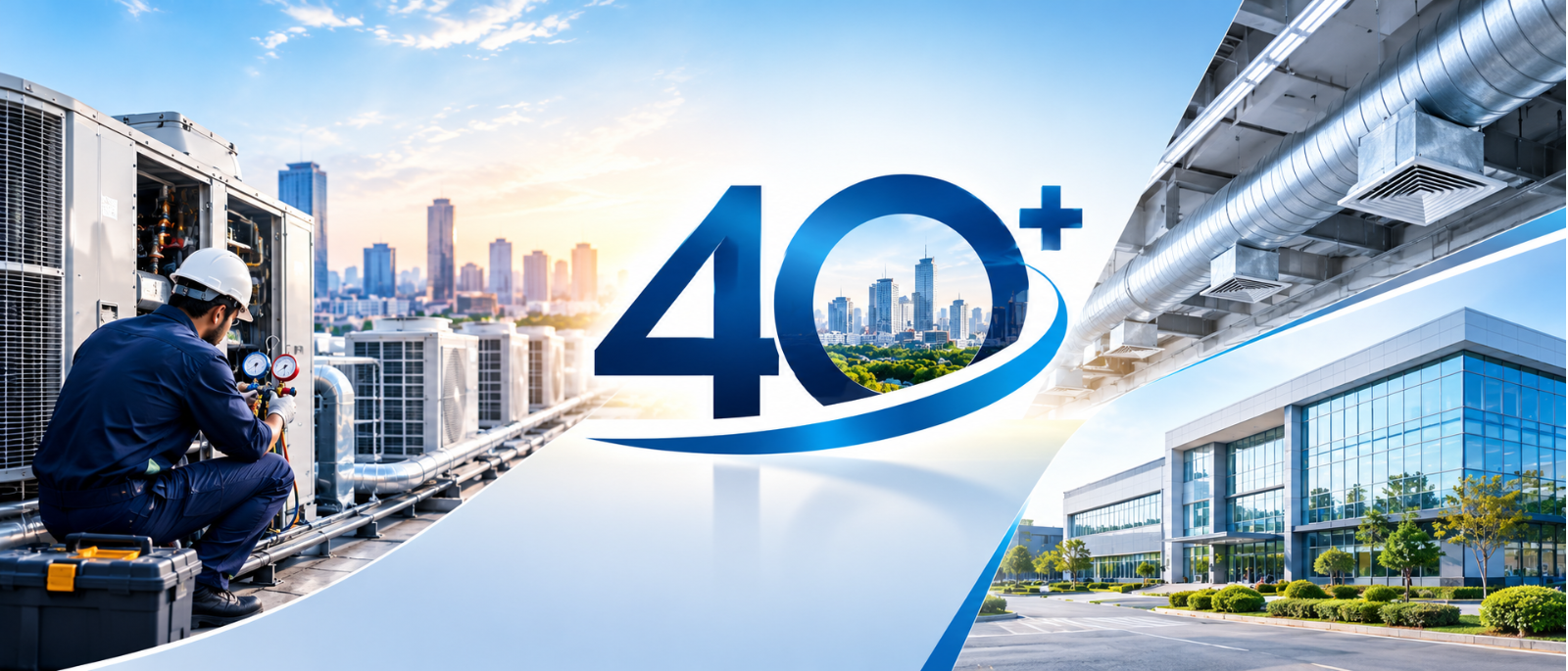
In commercial and industrial infrastructure, HVAC is far more than a cooling system. It is an important part of the building’s operational infrastructure, influencing indoor comfort, energy consumption, air quality, equipment performance and day-to-day continuity.
That is why choosing an HVAC partner requires more than comparing equipment specifications or project quotations.
Businesses need a partner with engineering knowledge, project execution capability, technical expertise and long-term service support.
For Vigasa Industries, this approach has been shaped by more than four decades in the HVAC field.
Established in 1990–91 by Mr. Vinod Sharma, a Mechanical Engineer, Vigasa Industries has developed its capabilities across HVACR, ventilation, utility piping, project execution, installation, commissioning and after-sales support.
Today, Vigasa positions itself as an end-to-end HVAC solutions provider for commercial, industrial, healthcare, institutional and other infrastructure requirements.
The journey reflects an important principle:
Long-term HVAC excellence is built through engineering experience, disciplined execution and continued support—not simply through supplying equipment.
Over 40 Years of HVAC Experience
Vigasa Industries was established in 1990–91 by Mr. Vinod Sharma, a Mechanical Engineer and Member of the Institute of Standard Engineers (India).
Since its establishment, the HVAC industry has changed considerably.
Buildings have become more complex. Energy efficiency has become increasingly important. Businesses now expect better environmental control, improved ventilation, smarter system selection and stronger lifecycle support.
Over the years, Vigasa has developed its capabilities around these changing requirements.
Its current scope includes Heating, Ventilation, Air Conditioning and Refrigeration (HVACR), utility piping and mechanical services, along with design, project execution and after-sales support.
The company also states that it has worked with major equipment brands and has executed projects in India as well as overseas. Its official history notes a relationship with Voltas beginning in 2005 and an association with Mitsubishi Electric India beginning in 2014.
This evolution illustrates how an HVAC business can grow by combining industry experience with changing technologies and project requirements.
From HVAC Expertise to Complete Project Solutions
A commercial or industrial HVAC project involves considerably more than selecting an air-conditioning unit.
The system has to work within the building’s architecture, electrical infrastructure, available space, operational requirements and project schedule.
A successful HVAC project can therefore involve:
- Requirement assessment
- Site inspection
- Heat-load evaluation
- System planning
- HVAC design and engineering
- Equipment selection
- Duct and piping coordination
- Installation
- Testing
- Balancing
- Commissioning
- Maintenance
- Technical support
Vigasa’s current project approach covers the process from site inspection and requirement analysis through design, installation, testing, commissioning and after-sales support.
This integrated approach is important for businesses looking for an HVAC partner rather than simply an equipment supplier.
HVAC Solutions for Commercial and Industrial Requirements
Different buildings have different HVAC requirements.
A corporate office may prioritize zoning, comfort and energy efficiency, while a manufacturing facility may have to address production heat loads, ventilation, process conditions and operational continuity.
Vigasa provides HVAC solutions across multiple sectors, including commercial and industrial environments.
Commercial Buildings
Commercial HVAC requirements can include:
- Corporate offices
- Commercial complexes
- Shopping and retail spaces
- Business parks
- Hospitality facilities
- Institutional buildings
Depending on the building, solutions may include centralized systems, VRF/VRV systems, packaged systems, ventilation and other air-conditioning configurations.
The appropriate solution depends on factors such as building size, occupancy, cooling load, zoning, operating hours and project objectives.
Industrial Facilities
Industrial environments can present more complex HVAC challenges.
Applications may include:
- Manufacturing plants
- Production facilities
- Warehouses
- Processing units
- Industrial buildings
Industrial HVAC planning may need to consider ventilation, heat generation, process requirements, air movement and the operating conditions of the facility.
Vigasa’s stated industry coverage includes manufacturing plants, warehouses, production facilities and processing units.
Specialized Requirements
Depending on project requirements, HVAC solutions can also involve:
- Chilled water systems
- VRF/VRV systems
- Air-conditioning systems
- Ventilation systems
- Utility piping
- Refrigeration
- Indoor air quality solutions
Vigasa’s official service information includes chilled-water and utility piping solutions as well as ventilation applications such as fresh air, exhaust air, pressurization and smoke extraction.
What Makes a Reliable HVAC Partner?
Selecting an HVAC company for a major project should involve more than comparing brands and prices.
Several capabilities deserve attention.
Engineering Experience
A capable HVAC partner should understand how the proposed system fits the building’s requirements.
This includes evaluating factors such as:
- Cooling requirements
- Building layout
- Occupancy
- Operating schedules
- Airflow
- Ventilation
- Equipment location
- Future requirements
Project Execution
Good design needs to translate into good execution.
Installation quality, coordination between trades, testing and commissioning can all influence the final performance of an HVAC system.
An experienced project team can help coordinate these stages more effectively.
Technical Expertise
Commercial and industrial HVAC projects can involve multiple technologies and system configurations.
A technically capable HVAC partner should be able to evaluate the project requirements before recommending an appropriate solution.
Long-Term Support
The relationship with an HVAC company should not necessarily end when installation is completed.
Maintenance, preventive inspections, troubleshooting and technical assistance can help businesses manage HVAC systems over their operating life.
Vigasa’s after-sales services include preventive maintenance programs, troubleshooting, equipment health monitoring, spare-parts support and AMC services.
Industry Understanding
An HVAC system designed for a corporate office may not be suitable for a manufacturing facility.
Understanding the operational environment is therefore essential when designing and implementing HVAC systems.
Why Experience Matters in Large HVAC Projects
Experience becomes particularly valuable when an HVAC project involves multiple systems, complex coordination or demanding operating conditions.
Correct System Selection
Different buildings require different HVAC configurations.
Experience can help project teams evaluate the requirements before selecting equipment and system architecture.
Energy Considerations
HVAC systems can represent a significant part of building energy consumption.
Proper system design, equipment selection, controls and maintenance can influence operational efficiency.
Space Planning
Large HVAC systems require careful planning for:
- Equipment rooms
- Duct routes
- Piping
- Electrical connections
- Service access
- Outdoor equipment
- Maintenance clearances
Early coordination can help avoid problems during installation.
Equipment Coordination
HVAC equipment needs to work alongside electrical, plumbing, structural and architectural systems.
Experienced project execution can help coordinate these interfaces.
Installation Challenges
Actual site conditions may differ from initial assumptions.
An experienced HVAC team needs to respond to site constraints while maintaining the intended system design.
Project Timelines
HVAC installation is often connected to the broader construction schedule.
Delays in equipment, ducting, piping or commissioning can affect other project activities.
Maintenance Planning
Maintenance should ideally be considered during system design rather than only after installation.
Accessibility, service requirements and preventive maintenance can all influence the long-term usability of the system.
Troubleshooting
HVAC systems are complex combinations of mechanical, electrical and control components.
Technical experience can be valuable when identifying the root cause of performance problems.
The key takeaway is simple:
HVAC performance depends on engineering and execution, not just the equipment selected.
Vigasa Industries’ Approach to HVAC Project Execution
A structured project methodology can help create consistency from initial planning through operation.
Vigasa’s current published process follows six broad stages.
Requirement Assessment
Understand the building, site conditions, operational requirements and client objectives.
↓
System Planning & Engineering
Develop the HVAC approach based on cooling requirements, building conditions and project objectives.
↓
Equipment Selection
Select suitable HVAC equipment and system configurations according to the project requirements.
↓
Installation & Execution
Execute installation while coordinating HVAC work with other site activities.
↓
Testing & Commissioning
Test, balance and commission the system before handover.
↓
Maintenance & Technical Support
Continue supporting system performance through maintenance and after-sales services.
This structured approach helps position HVAC as a complete engineering project rather than an equipment-delivery exercise.
Building Long-Term Trust Through HVAC Excellence
Trust in an HVAC company is built over time.
For a commercial or industrial client, trust can come from several factors:
- Consistent engineering practices
- Reliable project execution
- Technical communication
- Quality-focused installation
- Testing and commissioning
- Responsive support
- Maintenance capabilities
- Ability to adapt to changing requirements
Vigasa describes its approach around engineering expertise, customized solutions, quality assurance, energy efficiency, safety and long-term partnership.
Its after-sales service offering also emphasizes preventive maintenance, technical support and long-term equipment reliability.
This is important because the real measure of an HVAC partner is not only what happens during installation.
It is also how the system is supported after it becomes part of the client’s daily operations.
HVAC Technologies and Solutions
Vigasa’s HVAC portfolio covers multiple technologies and applications rather than a single system type.
Chiller Systems
Chilled-water systems can be considered for larger commercial and industrial cooling requirements where centralized cooling is appropriate.
VRF/VRV Systems
Variable Refrigerant Flow systems can provide zoned temperature control and flexibility for suitable commercial applications.
Air-Conditioning Systems
Depending on project requirements, air-conditioning solutions can include packaged and ductable systems as well as other configurations.
Ventilation Systems
Ventilation solutions can address requirements such as fresh-air supply, exhaust, pressurization, smoke extraction and indoor air quality.
Utility Piping
Large HVAC installations can require chilled-water, condenser-water, steam and other utility piping networks.
Vigasa identifies utility piping as part of its broader HVAC and mechanical-services capability.
HVAC Turnkey Solutions
For projects requiring multiple stages of execution, an integrated turnkey approach can bring design, supply, installation, testing, commissioning and support under a coordinated project structure.
The appropriate technology should always be determined according to the project’s actual requirements rather than selecting a system solely because it is popular.
Choosing the Right HVAC Company for Your Project
For businesses evaluating an HVAC contractor or solutions provider, the following checklist can help.
1. Industry Experience
Look for demonstrated experience relevant to the scale and type of your project.
2. Engineering Capabilities
Ask whether the company can handle design, calculations, planning and system selection—not simply equipment supply.
3. Project Execution Experience
Evaluate installation, coordination, testing and commissioning capabilities.
4. Technology Expertise
Understand which HVAC systems and applications the company works with.
5. Installation Capability
Confirm that the contractor has the technical and site resources required for the project.
6. Testing and Commissioning
Commissioning is essential for verifying that the installed system performs according to the intended design.
7. Maintenance Support
Ask about AMC programs, preventive maintenance and troubleshooting support after project completion.
8. Understanding of Project Timelines
HVAC activities need to align with the broader construction and operational schedule.
9. Safety and Quality Practices
Review how the contractor approaches site safety, quality control and installation standards.
10. Complete-Solution Capability
A project may benefit from a partner capable of coordinating multiple stages from design through after-sales support.
These factors can help businesses distinguish between an HVAC equipment vendor and a project-oriented HVAC engineering partner.
Why Choose Vigasa Industries?
Vigasa Industries combines its long operating history with engineering, project execution and after-sales capabilities.
Key strengths highlighted by the company include:
40+ Years of HVAC Industry Experience
Established in 1990–91, Vigasa brings more than four decades of industry experience.
Engineering-Led Approach
The company was founded by Mr. Vinod Sharma, a Mechanical Engineer, and positions engineering as a core part of its HVAC approach.
Commercial and Industrial Expertise
Vigasa serves commercial and industrial environments alongside healthcare, institutional and residential projects.
Project Execution Capabilities
Its published services cover design and planning, installation, testing, balancing, commissioning and project management.
HVACR Solutions
The company’s scope extends across HVACR, ventilation, utility piping and related mechanical services.
Maintenance and After-Sales Support
Vigasa provides preventive maintenance, troubleshooting, AMC programs and technical support after project completion.
Experience With Established Equipment Brands
Vigasa’s company history records relationships with Voltas and Mitsubishi Electric India, including its appointment as a Voltas System Solution Provider and Mitsubishi Electric authorized dealer.
Together, these capabilities support Vigasa’s positioning as a commercial and industrial HVAC project partner, rather than simply a supplier of HVAC equipment.
Conclusion: Experience That Goes Beyond Equipment
More than 40 years in HVAC is valuable when that experience translates into better engineering decisions, disciplined project execution and dependable long-term support.
Since its establishment in 1990–91, Vigasa Industries has developed from its engineering foundation into an HVACR solutions provider offering design, project execution, installation, commissioning, ventilation, utility piping and after-sales services.
For businesses planning commercial or industrial HVAC projects, the right partner should be evaluated on more than the equipment it supplies.
Look at the complete capability:
Experience → Engineering → Execution → Commissioning → Maintenance → Long-Term Support
That is where an HVAC company’s experience can create meaningful value.
For organizations looking for an experienced partner for commercial HVAC solutions, industrial HVAC projects and integrated HVACR requirements, Vigasa Industries brings more than four decades of industry experience and a project-focused approach.
Frequently Asked Questions
Vigasa Industries was established in 1990–91, giving the company more than 40 years of experience in the HVAC field. It was founded by Mr. Vinod Sharma, a Mechanical Engineer.
Vigasa provides HVAC solutions for commercial, industrial, healthcare, institutional and residential environments. Its services include HVAC projects, design and planning, project execution, ventilation, utility piping and after-sales support.
Yes. Vigasa provides HVAC solutions for corporate offices, commercial complexes, business parks, retail spaces and other commercial environments.
Yes. Vigasa identifies manufacturing plants, production facilities, warehouses and processing units among the industrial environments it serves.
Depending on project requirements, Vigasa works across HVACR technologies and solutions including chilled-water systems, VRF/VRV, packaged and ductable air-conditioning, ventilation and utility piping.
Yes. The company’s published project process includes installation, testing, balancing and commissioning as part of its project execution services.
Yes. Vigasa provides after-sales support, preventive maintenance programs, troubleshooting and Annual Maintenance Contracts (AMCs).
Experience can help an HVAC partner make better-informed decisions around system selection, engineering, space planning, installation coordination, commissioning, maintenance and troubleshooting. However, experience should be evaluated alongside current technical capabilities, relevant project experience and service support.