
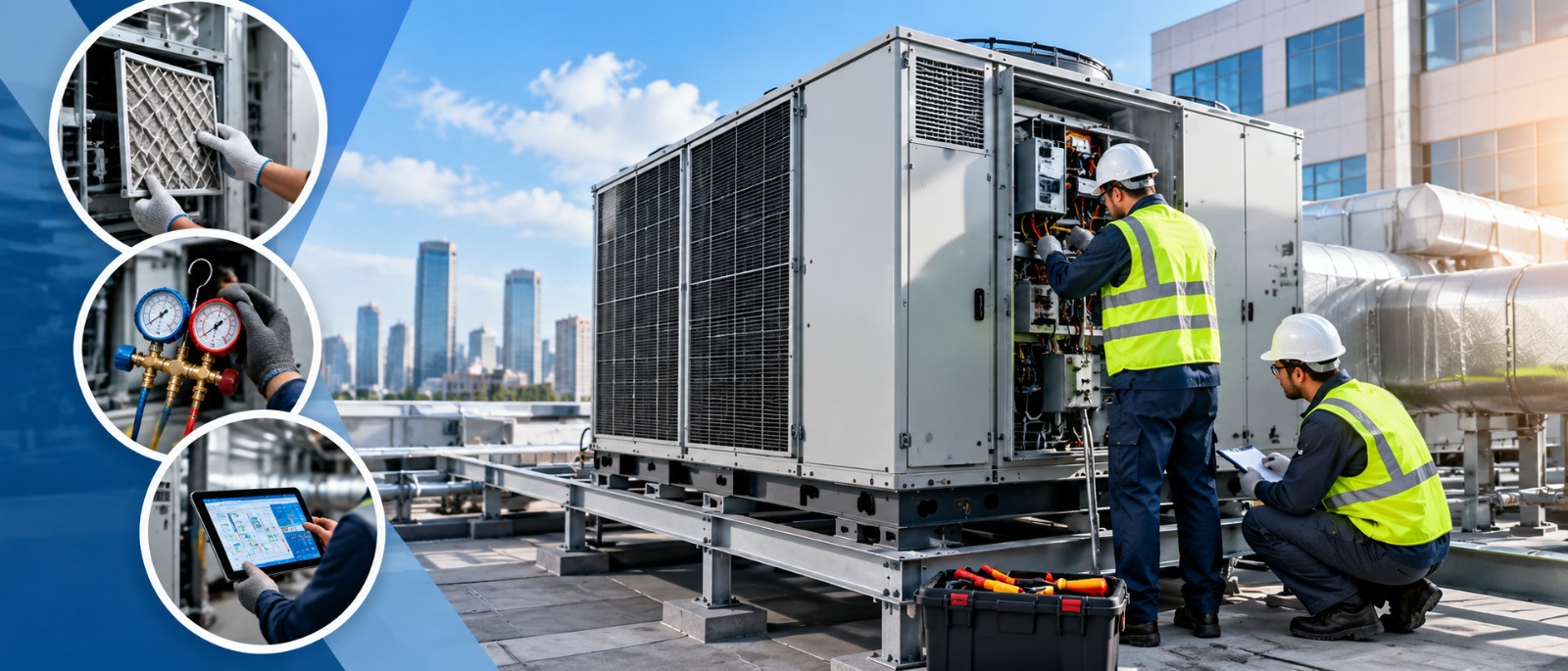
A commercial HVAC system is a major investment, and keeping it running efficiently requires more than fixing problems when they occur.
Regular preventive maintenance for commercial HVAC systems helps businesses identify potential issues before they become major failures. It can support reliable operation, maintain indoor comfort, improve system performance, and reduce unexpected downtime.
From offices and hotels to hospitals, shopping centres, industrial facilities, and large commercial buildings, HVAC systems operate for long hours under varying loads. Without an appropriate maintenance plan, components can become dirty, worn, inefficient, or difficult to operate.
A structured preventive maintenance program helps facility teams move from a reactive “repair when it fails” approach to a more proactive strategy.
What Is Preventive Maintenance for Commercial HVAC Systems?
Preventive HVAC maintenance is the planned inspection, cleaning, testing, adjustment, and servicing of HVAC equipment at predetermined intervals.
Rather than waiting for a compressor, fan, pump, filter, or control system to fail, maintenance teams periodically inspect components and address developing problems.
A commercial HVAC preventive maintenance program may include:
- Filter inspection and replacement
- Coil cleaning
- Condenser inspection
- Evaporator inspection
- Refrigerant-system checks
- Electrical connection inspection
- Fan and motor inspection
- Belt and bearing checks
- Drain-line cleaning
- Ductwork inspection
- Thermostat and sensor testing
- Control-system checks
- Chiller inspection
- Cooling-tower maintenance
- Air-handling-unit servicing
- Performance monitoring
- Safety checks
The exact maintenance schedule should be based on the type of equipment, operating conditions, manufacturer’s recommendations, building use, and applicable requirements.
Why Is Preventive HVAC Maintenance Important?
Commercial HVAC systems directly influence building comfort and operations.
An unexpected HVAC failure can affect employees, customers, guests, tenants, production processes, or critical equipment.
Preventive maintenance helps businesses identify issues before they become larger operational problems.
Key benefits include:
- Improved system reliability
- More consistent indoor comfort
- Better equipment performance
- Reduced unexpected breakdowns
- Improved energy performance
- Longer equipment service life
- Better indoor air quality
- Easier budgeting for maintenance
- Improved operational planning
Maintenance should therefore be viewed as part of asset management, not simply as an emergency repair expense.
Preventive Maintenance vs Reactive Maintenance
The difference between preventive and reactive maintenance is straightforward.
Reactive Maintenance
The system develops a problem → the equipment fails or performance drops → technicians are called → repairs are performed.
Preventive Maintenance
Equipment is inspected regularly → developing issues are identified → corrective action is taken → major breakdowns are less likely to occur unexpectedly.
Reactive maintenance will always have a role because unexpected faults can occur. However, relying entirely on breakdown-based maintenance can result in higher disruption and unpredictable repair requirements.
A preventive approach provides greater visibility into the condition of the HVAC system.
10 Important Areas of Commercial HVAC Preventive Maintenance
1. Air Filter Inspection and Replacement
Air filters are among the simplest HVAC components to maintain, but they can have a significant impact on system operation.
Dirty or clogged filters can restrict airflow and make the system work harder.
Maintenance teams should check filters according to the equipment and building conditions and replace or clean them as appropriate.
The required frequency can vary depending on:
- Building occupancy
- Outdoor air quality
- Construction activity
- Operating hours
- Equipment type
- Filter type
- Indoor air-quality requirements
A busy commercial facility may require more frequent inspection than a lightly occupied building.
2. Evaporator and Condenser Coil Cleaning
Coils transfer heat as part of the cooling process.
Over time, dust, dirt, debris, and other contaminants can accumulate on coil surfaces and reduce heat-transfer performance.
Routine inspection and cleaning can help maintain appropriate airflow and heat transfer.
For air-conditioning systems, maintenance teams may inspect:
- Evaporator coils
- Condenser coils
- Coil fins
- Coil cleanliness
- Airflow around coils
Cleaning methods should be appropriate for the specific equipment and manufacturer’s recommendations.
3. Fan and Motor Inspection
Fans are essential for moving air through HVAC systems.
Maintenance should include inspection of:
- Fan blades
- Motors
- Bearings
- Belts
- Pulleys
- Vibration
- Alignment
- Electrical connections
Unusual noise, vibration, overheating, or reduced airflow can indicate a developing problem.
Identifying these symptoms early can help prevent more serious equipment damage.
4. Electrical System Checks
Commercial HVAC equipment contains multiple electrical components.
Maintenance teams may inspect:
- Electrical connections
- Contactors
- Relays
- Control panels
- Motors
- Wiring
- Voltage and current conditions
- Safety devices
Loose connections, damaged wiring, or abnormal electrical readings should be addressed by qualified personnel.
Electrical maintenance is particularly important because HVAC equipment often operates for extended periods and may experience significant electrical loads.
5. Refrigerant System Inspection
For refrigeration-based air-conditioning systems, refrigerant performance is an important part of system operation.
Maintenance professionals can check for signs of:
- Refrigerant leakage
- Abnormal pressures
- Temperature irregularities
- Poor cooling performance
- Unusual compressor behaviour
Refrigerant-related work should be performed by appropriately trained and qualified technicians using procedures suitable for the specific system.
A system that is not performing correctly should be diagnosed rather than simply adding refrigerant without determining the underlying cause.
6. Drain Lines and Condensate Systems
Air-conditioning systems generate condensate during normal operation.
Drain pans and condensate lines can become blocked by dirt, biological growth, or debris.
If drainage is restricted, water can overflow and potentially damage ceilings, equipment, insulation, or surrounding areas.
Preventive maintenance should therefore include inspection and cleaning of:
- Drain pans
- Condensate pipes
- Drain traps
- Pumps
- Drain outlets
This is especially important for air-handling units and equipment installed above occupied spaces.
7. Ductwork Inspection
The duct system distributes conditioned air throughout the building.
Maintenance teams should look for:
- Air leakage
- Damaged insulation
- Loose connections
- Contamination
- Damaged duct sections
- Improperly sealed joints
- Airflow problems
Poor duct condition can affect system performance and comfort.
In commercial buildings, ductwork maintenance should be coordinated with the building’s overall ventilation and indoor-air-quality strategy.
8. Thermostats, Sensors and Controls
Modern HVAC systems depend heavily on controls.
Temperature sensors, thermostats, actuators, control panels, and building automation systems help regulate system operation.
Maintenance should verify that:
- Sensors are functioning correctly
- Temperature readings are appropriate
- Thermostats respond correctly
- Control sequences operate as intended
- Actuators function properly
- Alarms are working
- Communication between control components is maintained
A technically efficient HVAC system can still perform poorly if its controls are incorrectly configured or malfunctioning.
9. Chiller and Cooling Plant Maintenance
Large commercial facilities may use central chilled-water systems.
A preventive maintenance program for a cooling plant can involve inspection of:
- Chillers
- Pumps
- Cooling towers
- Heat exchangers
- Valves
- Expansion systems
- Water quality
- Controls
- Motors
- Electrical systems
Cooling towers may also require appropriate cleaning, water treatment, and inspection to maintain performance and hygiene.
Because central plants can be critical to large facilities, maintenance should follow equipment-specific requirements and established operational procedures.
10. Air Handling Unit Maintenance
AHUs are central to air distribution in many commercial HVAC systems.
Routine maintenance can include inspection of:
- Filters
- Coils
- Fans
- Motors
- Belts
- Bearings
- Dampers
- Drain pans
- Actuators
- Sensors
- Insulation
- Vibration
AHU maintenance can help maintain appropriate airflow and system performance while supporting the building’s ventilation strategy.
Commercial HVAC Preventive Maintenance Checklist
A structured checklist makes maintenance easier to track.
| Component | Maintenance Activity |
| Filters | Inspect, clean or replace as appropriate |
| Coils | Inspect and clean |
| Fans | Check operation and vibration |
| Motors | Inspect condition and electrical performance |
| Belts | Check tension and wear |
| Bearings | Inspect and lubricate where applicable |
| Electrical panels | Inspect connections and components |
| Refrigeration system | Check operating condition and signs of leakage |
| Drain system | Clean and inspect |
| Ductwork | Check condition, leakage and insulation |
| Thermostats | Test operation |
| Sensors | Verify readings |
| Controls | Check operation and alarms |
| AHUs | Inspect and service major components |
| Chillers | Inspect according to manufacturer requirements |
| Cooling towers | Inspect, clean and maintain water treatment |
| Safety systems | Verify appropriate operation |
The actual checklist should always be adapted to the equipment and site.
How Often Should Commercial HVAC Maintenance Be Done?
There is no single maintenance interval that applies to every commercial HVAC system.
The appropriate frequency depends on:
- Equipment type
- Building size
- Operating hours
- Occupancy
- Climate
- Outdoor air quality
- Equipment age
- Manufacturer recommendations
- Criticality of the facility
- Environmental conditions
A practical maintenance program may include different activities on monthly, quarterly, half-yearly, and annual schedules.
For example:
Monthly
- Filter condition
- Visible leaks
- Unusual noise
- Temperature complaints
- Basic equipment inspection
- Control alarms
Quarterly
- Coils
- Fans and belts
- Electrical components
- Drain systems
- Sensors
- General equipment condition
Half-Yearly
- Deeper equipment inspection
- Ductwork condition
- Motor and bearing checks
- Control-system review
- Performance assessment
Annually
- Comprehensive system inspection
- Major equipment servicing
- Chiller and cooling-plant checks where applicable
- Performance evaluation
- Maintenance-history review
- Recommendations for repairs or upgrades
These are general planning intervals, not universal requirements. Equipment-specific instructions and site conditions should determine the final schedule.
Signs Your Commercial HVAC System Needs Maintenance
Businesses should not wait for a complete system failure before investigating performance problems.
Warning signs can include:
Uneven Cooling
Some rooms are comfortable while others remain too warm or too cold.
Increasing Energy Consumption
Unexpected increases in HVAC energy use can indicate reduced system efficiency or changing operating conditions.
Unusual Sounds
Grinding, rattling, squealing, or other abnormal sounds may indicate mechanical problems.
Reduced Airflow
Weak airflow from diffusers can be caused by filter, duct, fan, damper, or other issues.
Frequent Cycling
Repeated starting and stopping may indicate control, sizing, airflow, or equipment problems.
Water Leakage
Leaks around air-conditioning equipment can indicate blocked drains or other issues requiring inspection.
Unusual Odours
Persistent odours may indicate problems involving filters, coils, drainage, or other components.
Temperature-Control Problems
If thermostats or building controls cannot maintain the desired conditions, professional diagnosis may be required.
Preventive Maintenance and Energy Efficiency
Maintenance alone cannot turn an inefficient HVAC system into a high-efficiency system, but poor maintenance can negatively affect system performance.
Dirty filters, fouled coils, poorly operating fans, incorrect controls, and other issues can contribute to inefficient operation.
A comprehensive maintenance program should therefore consider both:
Equipment condition + System performance
For example, a maintenance inspection can identify whether:
- Airflow is appropriate
- Coils are clean
- Filters are restricting airflow
- Fans are operating correctly
- Controls are functioning
- Equipment is operating within expected conditions
This information can help facility managers identify opportunities for corrective maintenance or energy-efficiency improvements.
Preventive Maintenance for Different Commercial Facilities
Different buildings require different maintenance strategies.
Office Buildings
Focus areas may include:
- AHUs
- Filters
- Temperature control
- Ventilation
- Zoning
- Occupant comfort
Hotels
Maintenance may need to cover:
- Guest-room units
- Central HVAC equipment
- Common areas
- Kitchen ventilation
- Controls
- Extended operating schedules
Hospitals
Healthcare facilities can have specialised ventilation, filtration, pressure-control, and environmental requirements. Maintenance must follow the facility’s specific procedures and applicable healthcare standards.
Shopping Malls
Large retail facilities may require maintenance of:
- Central cooling plants
- AHUs
- Large air-distribution systems
- Ventilation
- Controls
- High-occupancy areas
Industrial Facilities
Industrial HVAC maintenance may involve both comfort systems and process-related cooling or ventilation equipment.
The maintenance plan should therefore be developed around the facility’s actual operational requirements.
Why HVAC Maintenance Records Matter
A professional maintenance program should not rely only on verbal updates.
Maintenance records can provide valuable information about the condition and history of the HVAC system.
Records can include:
- Service dates
- Equipment details
- Inspection findings
- Parts replaced
- Repairs completed
- Operating readings
- Recurring faults
- Filter replacement history
- Recommendations
- Pending maintenance
Over time, this information can help facility managers identify recurring problems and make better decisions about repairs, replacement, upgrades, and budgeting.
When Should You Consider HVAC AMC Services?
For commercial facilities with multiple HVAC systems or long operating hours, an Annual Maintenance Contract (AMC) can provide a structured approach to ongoing maintenance.
An AMC can help businesses establish:
- Planned inspection schedules
- Routine servicing
- Preventive maintenance
- Breakdown support
- Maintenance documentation
- Performance monitoring
- Equipment-history tracking
The exact scope of an AMC should be defined according to the facility, equipment inventory, response requirements, and maintenance objectives.
For large commercial sites, having a dedicated HVAC maintenance partner can make it easier to manage multiple systems and planned maintenance activities.
Preventive Maintenance vs HVAC Replacement
Preventive maintenance can help maintain existing equipment, but it does not mean every ageing HVAC system should continue operating indefinitely.
Replacement or major upgrades may need to be considered when:
- Equipment experiences frequent breakdowns
- Repair costs continue increasing
- Major components are approaching the end of their useful life
- Performance has significantly declined
- Spare parts are difficult to obtain
- Energy performance is no longer suitable
- The building’s cooling requirements have changed
A professional assessment can help determine whether continued maintenance, repair, system optimisation, or replacement is the most appropriate option.
Common Commercial HVAC Maintenance Mistakes
Waiting Until Equipment Fails
Breakdown-only maintenance can result in unexpected downtime.
Ignoring Small Problems
A minor leak, unusual vibration, or airflow issue can sometimes indicate a larger developing problem.
Using the Same Schedule for Every Building
Maintenance frequency should reflect equipment and site conditions.
Focusing Only on Filters
Filters are important, but commercial HVAC maintenance involves many other components.
Neglecting Controls
Incorrect sensors or control sequences can affect comfort and energy performance.
Skipping Documentation
Without maintenance records, it becomes difficult to identify recurring issues or track equipment history.
Delaying Recommended Repairs
A preventive inspection only creates value if identified issues are addressed appropriately.
How to Build an Effective HVAC Preventive Maintenance Plan
A practical maintenance program can follow these steps:
Step 1: Create an Equipment Inventory
Document all HVAC equipment, including model, capacity, location, age, and criticality.
Step 2: Identify Maintenance Requirements
Review manufacturer recommendations, site conditions, operational schedules, and applicable requirements.
Step 3: Establish Maintenance Frequencies
Create monthly, quarterly, half-yearly, and annual tasks where appropriate.
Step 4: Create Inspection Checklists
Use equipment-specific checklists rather than a generic list for every system.
Step 5: Record Findings
Document inspections, repairs, measurements, and observations.
Step 6: Prioritise Corrective Work
Classify identified issues according to urgency and operational impact.
Step 7: Monitor Performance
Track recurring problems, energy performance, comfort complaints, and equipment condition.
Step 8: Review the Program
Maintenance plans should evolve as equipment ages, building use changes, and operational requirements develop.
Why Choose Vigasa Industries for Commercial HVAC Maintenance?
Vigasa Industries provides HVACR solutions for commercial and industrial applications, including HVAC maintenance and related services.
The company’s stated service capabilities include commercial HVAC systems, industrial HVAC solutions, central air-conditioning systems, VRF/VRV systems, chillers and cooling plants, ventilation and ducting, HVAC maintenance, and energy-efficiency solutions.
For businesses managing critical HVAC infrastructure, a maintenance partner can help organise preventive servicing, identify developing equipment issues, and support reliable system operation.
A professional HVAC maintenance approach can cover the complete lifecycle:
Inspection → Preventive Maintenance → Performance Assessment → Corrective Action → Documentation → Ongoing Monitoring
This approach allows businesses to move beyond emergency repairs and build a more structured HVAC maintenance strategy.
Final Thoughts
Commercial HVAC systems are essential to the comfort, productivity, and operation of many modern buildings.
But even well-designed HVAC equipment requires regular attention.
A structured preventive maintenance program helps businesses monitor equipment condition, identify developing problems, maintain appropriate performance, and plan corrective work before issues become major disruptions.
The most effective maintenance strategy is not simply about cleaning equipment once in a while. It is about creating a planned, documented, equipment-specific program that considers the building, operating conditions, equipment condition, and long-term objectives.
For commercial and industrial facilities, partnering with an experienced HVAC service provider can make preventive maintenance more organised and effective.
Vigasa Industries helps businesses manage commercial and industrial HVAC requirements with design, execution, maintenance, and energy-efficiency solutions tailored to project needs.
Frequently Asked Questions
Preventive HVAC maintenance is the planned inspection, cleaning, testing, adjustment, and servicing of HVAC equipment at scheduled intervals to maintain performance and identify developing issues.
The appropriate frequency depends on equipment type, operating hours, building conditions, climate, occupancy, manufacturer recommendations, and the criticality of the facility. Maintenance activities can be scheduled at different intervals rather than using one frequency for every component.
It can include filter inspection, coil cleaning, fan and motor checks, electrical inspection, drain cleaning, ductwork inspection, controls testing, refrigerant-system checks, AHU servicing, chiller maintenance, cooling-tower maintenance, and performance assessment.
Preventive maintenance is intended to identify and address developing problems before they result in unexpected failures. However, no maintenance program can eliminate every possible breakdown.
Proper maintenance can help an HVAC system continue operating as intended. Dirty filters, fouled coils, airflow problems, malfunctioning controls, and other faults can negatively affect system performance.
An HVAC Annual Maintenance Contract is an ongoing service arrangement covering defined inspection, preventive maintenance, servicing, and potentially breakdown-support activities for HVAC equipment.
Replacement may need to be evaluated when equipment has frequent failures, rising repair costs, declining performance, limited parts availability, or no longer meets the building’s operational requirements.
Maintenance records provide a history of inspections, repairs, component replacements, recurring faults, and recommendations. This information can support better maintenance planning and asset-management decisions.
Vigasa Industries offers HVAC maintenance as part of its commercial and industrial HVAC service capabilities, alongside HVAC design, installation, central air-conditioning, VRF/VRV, chiller and cooling-plant, ventilation, and energy-efficiency solutions.