
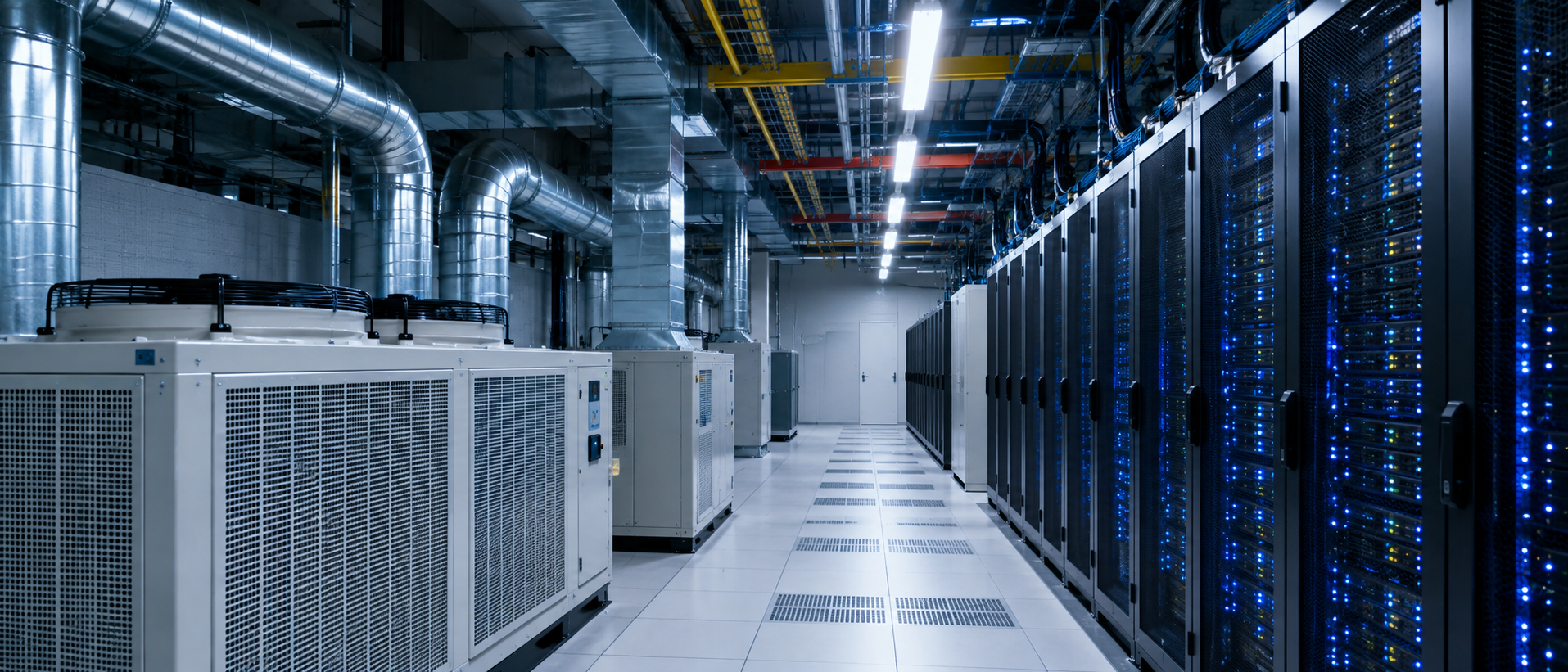
A data center can’t afford an HVAC system that simply “works most of the time.” Servers generate heat continuously, and even a short period of inadequate cooling can affect equipment performance, uptime, and business operations. This is why businesses looking for HVAC services in Delhi NCR need a solution designed specifically for the demands of IT environments.
Unlike a conventional office, a server room may have high heat loads even when only a few people occupy the space. Temperature, humidity, airflow, redundancy, and monitoring all need to work together. In this guide, we’ll look at how Customized HVAC solutions support data centers and server rooms and what businesses should consider before selecting an Industrial HVAC solutions provider.
Why HVAC Is Critical for Data Centers
Servers, networking equipment, storage systems, and other IT hardware generate heat continuously.
As equipment density increases, that heat becomes more concentrated. Without proper cooling, temperatures can rise quickly and affect equipment reliability.
Therefore, HVAC isn’t simply a comfort system in a data center. It is part of the infrastructure that supports business continuity.
A properly designed cooling system helps maintain stable environmental conditions around the clock.
Why Server Rooms Need Specialized Cooling
A typical office has relatively predictable heat loads.
Server rooms are different.
The majority of the heat comes from electronic equipment, which means the cooling requirement can remain high even when the room has very few occupants.
A specialized system needs to account for:
- Server rack density
- Equipment heat generation
- Room dimensions
- Airflow patterns
- Operating hours
- Redundancy requirements
- Future equipment expansion
This is where standard commercial air conditioning may not always be sufficient.
Temperature Control in Data Centers
Temperature consistency is one of the most important requirements.
Simply lowering the room temperature isn’t the objective. The system needs to maintain stable conditions while responding to changing equipment loads.
Poor temperature management can create hot spots around server racks, even when the average room temperature appears acceptable.
Therefore, HVAC design should consider rack arrangement, supply-air distribution, return-air paths, and equipment placement.
A professional HVAC team can assess these factors before selecting the cooling system.
Humidity Control Matters Too
Temperature gets most of the attention, but humidity also matters.
Excessive humidity can create moisture-related concerns, while excessively dry conditions can increase the risk associated with static electricity.
The appropriate humidity range depends on the equipment and applicable project requirements.
For this reason, data center HVAC systems may require dedicated humidity monitoring and control rather than relying solely on conventional air conditioning.
Airflow and Heat Management
Cooling the room isn’t enough if cooled air doesn’t reach the equipment effectively.
Good airflow planning helps deliver conditioned air where it’s needed while removing warm air from equipment areas.
Depending on the facility, the design may incorporate:
- Raised-floor cooling
- Underfloor air distribution
- Hot aisle and cold aisle arrangements
- Precision air conditioning
- Dedicated return-air paths
- Variable-speed fans
The right approach depends on the building and server configuration.
Cooling Redundancy for Better Reliability
Data centers often operate continuously.
That means the cooling system also needs to be designed with reliability in mind.
If one cooling unit requires maintenance or experiences a fault, the remaining system should be capable of maintaining acceptable conditions according to the facility’s redundancy strategy.
Depending on the project, businesses may consider:
- Standby cooling units
- Redundant equipment
- Backup power
- Independent cooling circuits
- Automated changeover systems
Redundancy should be considered during the design stage rather than added later.
Energy Efficiency Without Compromising Performance
Data center cooling can consume significant energy.
However, reducing energy consumption should never come at the expense of equipment reliability.
Modern Customized HVAC solutions can incorporate high-efficiency equipment, variable-speed drives, intelligent controls, optimized airflow, and temperature monitoring.
These technologies allow cooling output to respond more closely to actual demand.
As a result, businesses can work toward better energy performance while maintaining the environmental conditions required by their IT infrastructure.
HVAC Monitoring and Smart Controls
Data center HVAC systems benefit from continuous monitoring.
Modern controls can track conditions such as:
- Temperature
- Humidity
- Equipment status
- Airflow
- Alarms
- Cooling performance
If conditions move outside predefined limits, alerts can help facility teams respond quickly.
This is particularly useful for facilities where even a short period of abnormal temperature can have serious consequences.
HVAC Solutions for Different Data Center Requirements
Not every data center has the same cooling requirements.
A small server room inside an office building may need a dedicated precision cooling system. A large enterprise data center may require multiple cooling units, redundant equipment, advanced controls, and carefully engineered airflow.
Colocation facilities, telecom rooms, edge data centers, and industrial server rooms can also have different requirements.
Therefore, HVAC selection should begin with a proper site assessment and cooling-load analysis.
Why Customized HVAC Solutions Make Sense
A standard air conditioning package may look attractive during the initial planning stage.
However, data centers have operational requirements that are difficult to address with one-size-fits-all systems.
Customized HVAC solutions allow engineers to consider the actual heat load, equipment layout, building structure, operating conditions, redundancy requirements, and future expansion plans.
This results in a cooling strategy designed around the facility rather than forcing the facility to adapt to a standard system.
Choosing the Right HVAC Partner in Delhi NCR
For data center projects, technical experience matters.
Businesses searching for HVAC services in Delhi NCR should look beyond equipment supply and evaluate the complete project capability of the HVAC provider.
Important factors include:
- Data center or server room experience
- HVAC engineering capabilities
- Cooling-load assessment
- Precision cooling expertise
- Installation capability
- Controls integration
- Testing and commissioning
- Preventive maintenance
- Emergency support
An experienced HVAC contractor should also understand the importance of uptime and coordination with electrical, IT, fire, and building management systems.
Planning for Long-Term Data Center Performance
Data center cooling shouldn’t be planned only for today’s server load.
IT requirements can change quickly. Additional racks may be added, equipment density may increase, and operating requirements can evolve. A good HVAC design considers these changes from the beginning.
At Vigasa Industries, we provide HVAC services in Delhi NCR and develop Customized HVAC solutions for commercial, industrial, and critical environments. Our approach combines engineering, equipment selection, installation, testing, commissioning, and maintenance to create cooling systems aligned with each facility’s actual requirements.
For data centers and server rooms, the objective is straightforward: maintain the right environment for critical equipment, support reliable operation, and build a cooling system that can keep up with the business.
Frequently Asked Questions
HVAC systems control temperature, humidity, and airflow around IT equipment. Proper cooling helps prevent overheating and supports reliable server operation.
It depends on the room size, equipment heat load, operating hours, and reliability requirements. Some small server rooms may use dedicated systems, while larger facilities typically require specialized cooling solutions.
Customized HVAC solutions are cooling systems designed around the facility's specific server load, rack arrangement, airflow requirements, redundancy needs, and future expansion plans.
Industrial HVAC solutions are designed for demanding environments such as manufacturing facilities, warehouses, process areas, data centers, and other applications requiring controlled temperature, ventilation, and air quality.
Look for an experienced provider with HVAC engineering, installation, commissioning, maintenance, controls, and critical-environment experience. A detailed site assessment should be completed before finalizing the system.
Yes. Preventive maintenance helps identify equipment issues, airflow problems, filter conditions, control faults, and other performance concerns before they affect the cooling system.